The US rifle platoon in the attack
United States; platoon, company level; 1942. 16 passages quoted from 2 wartime documents.
Filed under The attack.
In brief
The 1942 company manual (FM 7-10) treats the rifle platoon as the building block of a company attack. The company commander chooses how many platoons go into the attacking echelon, and each platoon gets a zone of action and an initial objective, advancing by fire and movement [1].
The manual also sets the platoon's own protection and the company's reserve. Platoons provide their own air-antitank guards and each is given a direction of possible tank attack, and the company holds back a support for counterattacks [1]. The 1942 battalion manual (FM 7-20) adds platoon passages on river crossings and on flank security [2].
Figures from the manuals
The manuals’ own sketches for this subject, cropped from the scans. Select one to enlarge it.
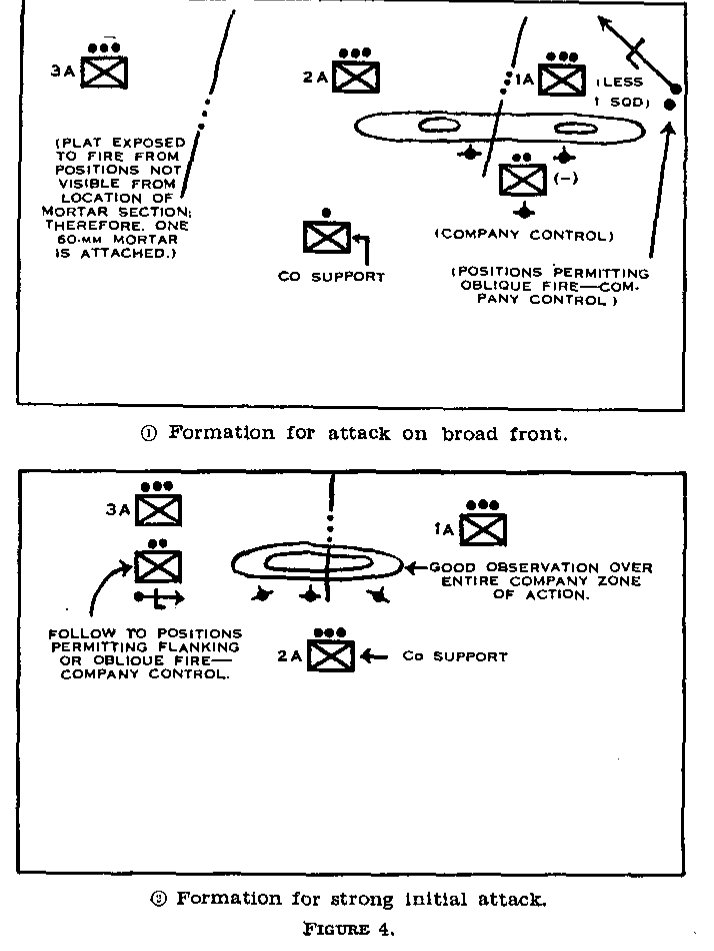
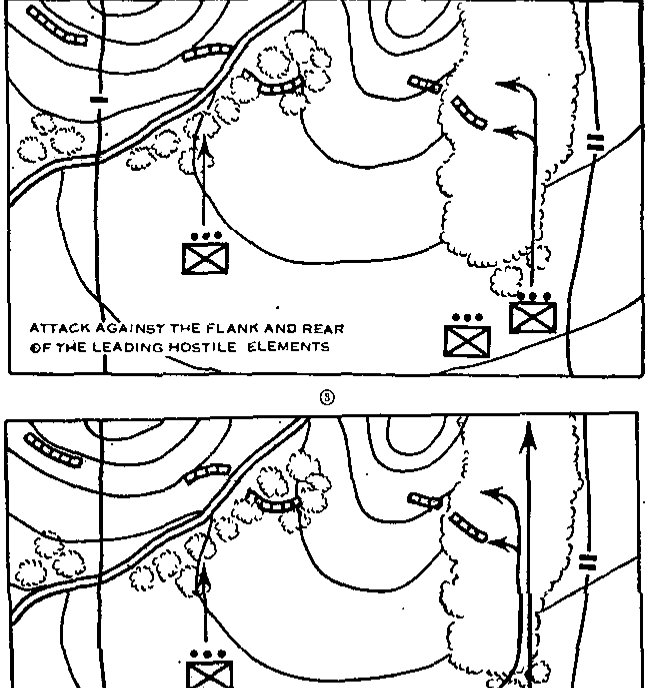
Forming the attacking echelon and crossing a river
The company manual calls an attack with all three platoons abreast exceptional, and two platoons up with one in support the usual formation [1]. For a river crossing, the battalion manual says rifle companies usually cross with three platoons abreast [2], so the formation depends on the operation.
The passages behind it, 4 quotations
Company attack, 1942
“A formation, for the initial attack, with all three rifle platoons (less a small fraction of one in support) abreast is exceptional”
Abreast means side by side. The exception is a small part of one platoon held in support.FM 7-10 Rifle Company (1942), p. 31 Company attack, 1942
“this formation is the one most frequently used”
"This formation" is two rifle platoons in the attacking echelon, with one in support.FM 7-10 Rifle Company (1942), p. 32 River crossing, rifle companies
“Rifle companies in the attacking echelon usually cross with three rifle platoons abreast.”
FM 7-20 Rifle Battalion (1942), p. 142 After river crossing
“Rifle platoons, followed by weapons platoons, then push forward”
FM 7-20 Rifle Battalion (1942), p. 145
Zones of action and initial objectives
Frontage and objectives are set together: each platoon gets its own zone, normally 100 to 200 yards wide, and an initial objective chosen for its place in the company's advance [1].
The passages behind it, 3 quotations
Company attack, 1942
“Each rifle platoon in the attacking echelon should be assigned a definite zone of action.”
FM 7-10 Rifle Company (1942), p. 34 Company attack, normal frontage
“Normally, the frontage assigned the platoon should not be less than 100 yards or more than 200 yards”
FM 7-10 Rifle Company (1942), p. 34 Company attack, 1942
“Each platoon should be assigned, as its initial objective, the nearest terrain feature or hostile position within its zone of action whose capture is essential to the further advance of the company as a whole.”
FM 7-10 Rifle Company (1942), p. 35
Fire and movement
The company manual ties movement to fire at every stage: each movement is covered by fire, and at the first firing position each platoon seeks fire superiority over the enemy to its front [1].
The passages behind it, 3 quotations
Company attack, movement
“Every movement must be covered (a) by fire delivered by part of the company by company supporting weapons, or both”
Lettered list: the cover comes from part of the company, from company supporting weapons, or from both.FM 7-10 Rifle Company (1942), p. 31 First firing position
“At the first firing position each attacking platoon seeks to gain fire superiority over the enemy to its front”
Fire superiority: having more effective fire on the enemy than he has on you.FM 7-10 Rifle Company (1942), p. 41 Opening fire
“Ordinarily fire is opened on orders of the platoon leader; the company commander may, however, reserve to himself the authority for opening fire in order to gain surprise.”
FM 7-10 Rifle Company (1942), p. 41
Protection against tanks and flank threats
The company manual places tank protection inside the platoon: each rifle platoon provides its own air-antitank guard and takes a direction of possible tank attack [1]. The battalion manual handles flank security at a different scale, where an interior flank seldom needs more than one rifle squad [2].
The passages behind it, 3 quotations
Company attack, 1942
“Rifle platoons provide their own air-antitank guards.”
Lookouts who give the platoon timely warning of air and tank ("mechanized") attack, per the same paragraph.FM 7-10 Rifle Company (1942), p. 40 Company attack, 1942
“Protection of the company as a whole is accomplished by assigning specific directions or areas of possible tank attack to each rifle platoon.”
FM 7-10 Rifle Company (1942), p. 40 Battalion attack, interior flank
“for an interior flank the size will seldom exceed one rifle squad”
"The size" refers to the force guarding the flank.FM 7-20 Rifle Battalion (1942), p. 93
Company support held back from the platoons
The manual treats the company support as a real maneuver force, not a leftover: it must be strong enough for its missions, with a rifle platoon the minimum on an exposed flank [1]. It cannot be drawn only from the weapons platoon, and it may wait in a concealed place until ordered forward [1].
The passages behind it, 3 quotations
Company attack, 1942
“It must be adequate in strength to accomplish its probable missions; with an exposed flank, a rifle platoon is usually the minimum.”
FM 7-10 Rifle Company (1942), p. 36 Company attack, 1942
“it cannot be taken only from the weapons platoon.”
"It" is the company support, which cannot be made up only of weapons platoon troops.FM 7-10 Rifle Company (1942), p. 36 Company attack, 1942
“In the attack order it may be assigned an initial concealed location and directed to await orders there.”
"It" means the company support.FM 7-10 Rifle Company (1942), p. 36