German Infantry Division (1944 type)
Germany, division, 1944-1945, as described in 1 wartime document.
The sources call it the “Infantry Division, 1944 Type”. Also written as Infanteriedivision n.A., Infantry Division, New Type.
Key figures
The latest figure printed for each. Select one to see every value, its quoted sentence and its page.
- Personnel (table of organization)
- 11,000 to 13,000Average German division tables, January 1945, 1945 source, 5 values
- Division headquarters
- 227Infantry Division, 1944 Type, 1945 source
- Light machine guns per rifle company
- 13After May 1944 (from 16), 1945 source
What the sources say
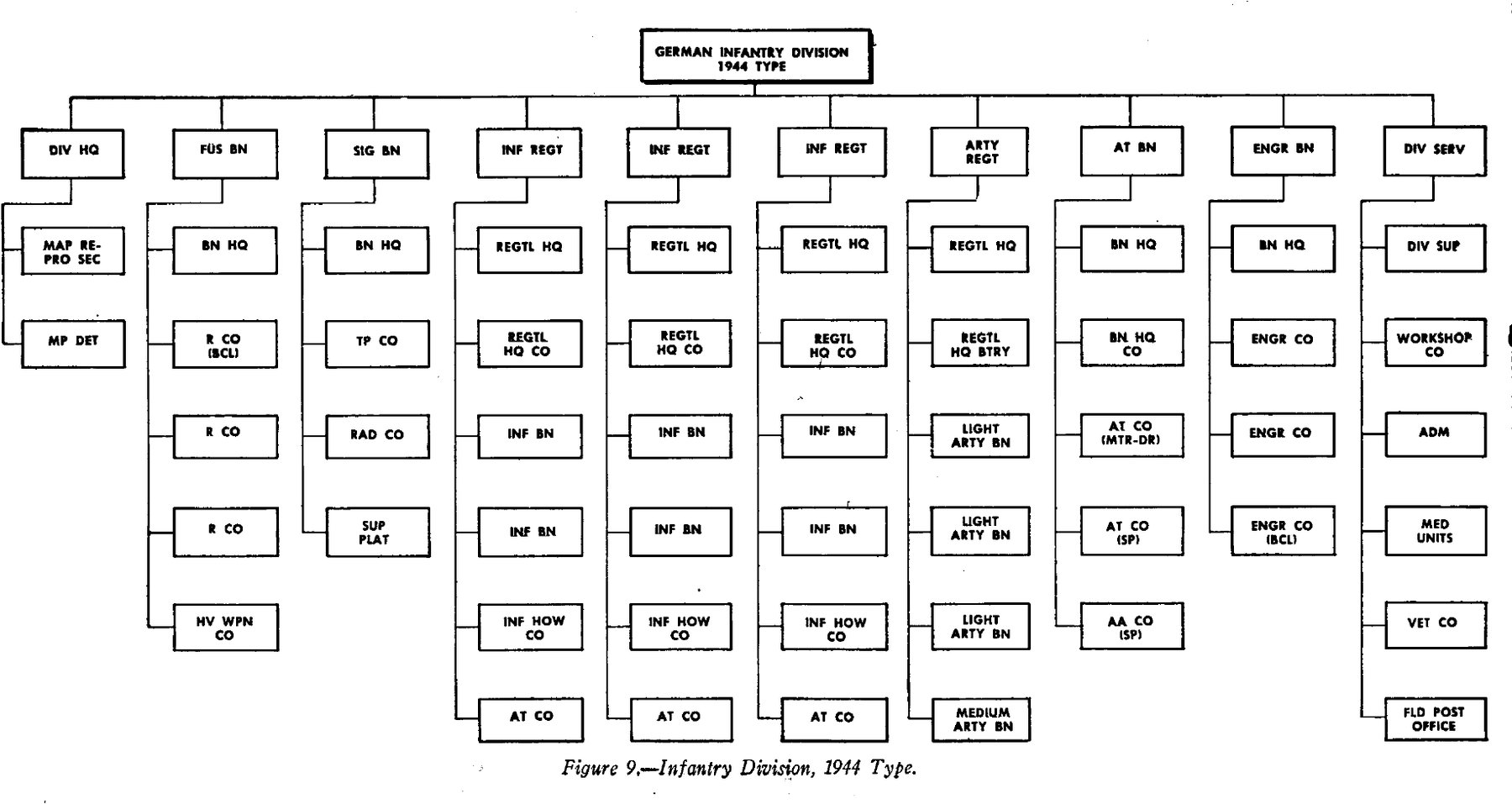
The Infantry Division, 1944 Type is the reduced German infantry division that US Army intelligence described in the March 1945 handbook TM-E 30-451. It has three infantry regiments of two battalions each, where the Old Type had three battalions per regiment [1]. The change dates to October 1943, when the infantry regiments went from three battalions to two and the rifle platoons went from four squads to three [1]. The type was renamed in May 1944 after further economies: squads fell from ten men to nine and light machine guns per rifle company from 16 to 13 [1].
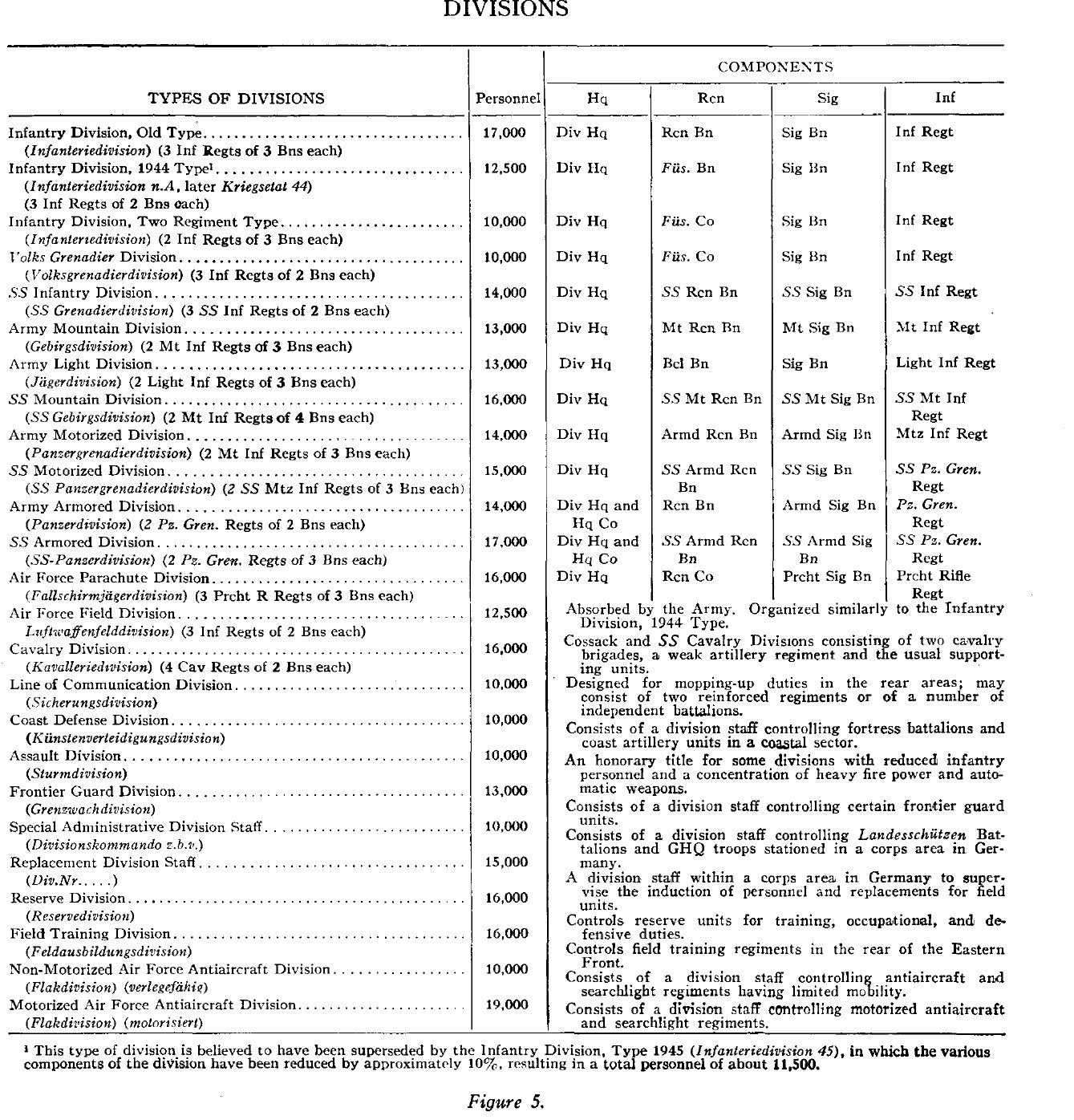
The handbook gives the division a table of organization strength of 12,500 men, compared with 17,000 for the Old Type and about 10,000 for the two-regiment division [1]. The average divisional table strength was about 15,000 to 17,000 before summer 1943 and about 11,000 to 13,000 by January 1945 [1]. The handbook says the type was to be cut by about 10 percent as Infantry Division, Type 1945, with a total personnel of about 11,500 [1].
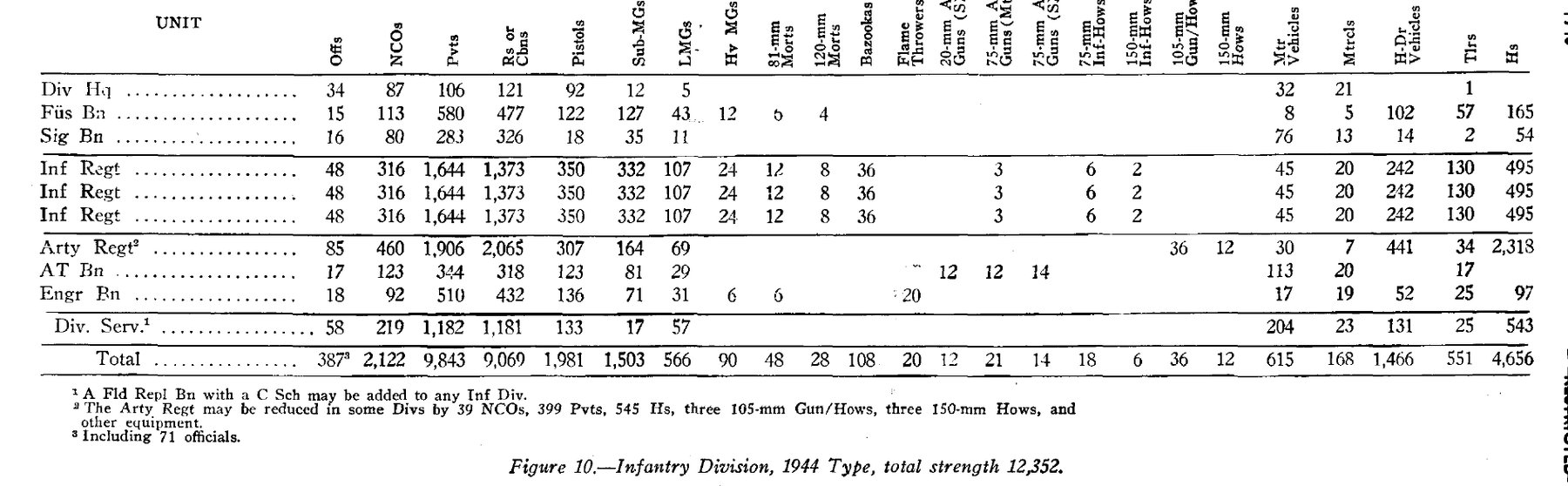
The handbook's component names for the division come from its organization chart, which lists a divisional fusilier battalion, an artillery regiment with light and medium battalions, an antitank battalion, an engineer battalion, a signal battalion and divisional services [1]. Each divisional unit is quoted from its figure label on p. 98 or its table row on p. 99. Counts of companies below battalion level follow those labels; the rifle company count inside an infantry battalion is not printed, so it is left unnumbered.
Organization
27 units as the documents lay them out. The number before a unit is how many of it sit in the unit above; the figure on the right is its strength as printed (per unit). Select a unit with an arrow to open or close what is under it. Page numbers are in Handbook on German Military Forces (TM-E 30-451) (1945).
Original charts and tables
The figures the outline and tables on this page were read from, cropped from the scans. Select one to open it at full size; the small print is legible there.
Strength, source by source
Personnel figures as the documents printed them, each with its sentence and page. Values run from the earliest source to the latest. 1 figure changed over time, as new models appeared and intelligence improved.
| Strength | Value as printedSource and quoted text |
|---|---|
| Personnel (table of organization)Changed over time | 12,500 (12500)Infantry Division, 1944 Type (Figure 5, March 1945) Handbook on German Military Forces (TM-E 30-451) (1945), p. 91“12.500” 17,000 (17000)Infantry Division, Old Type Handbook on German Military Forces (TM-E 30-451) (1945), p. 91“17,000” about 11,500 (11500)Infantry Division, Type 1945 (superseding) Handbook on German Military Forces (TM-E 30-451) (1945), p. 91“total personnel of about 11,500” 15,000 to 17,000Average German division, 1939 to summer 1943 Handbook on German Military Forces (TM-E 30-451) (1945), p. 90“period was about 15,000 to 17,000 and with the” 11,000 to 13,000Average German division tables, January 1945 Handbook on German Military Forces (TM-E 30-451) (1945), p. 90“13,000 in January 1945” |
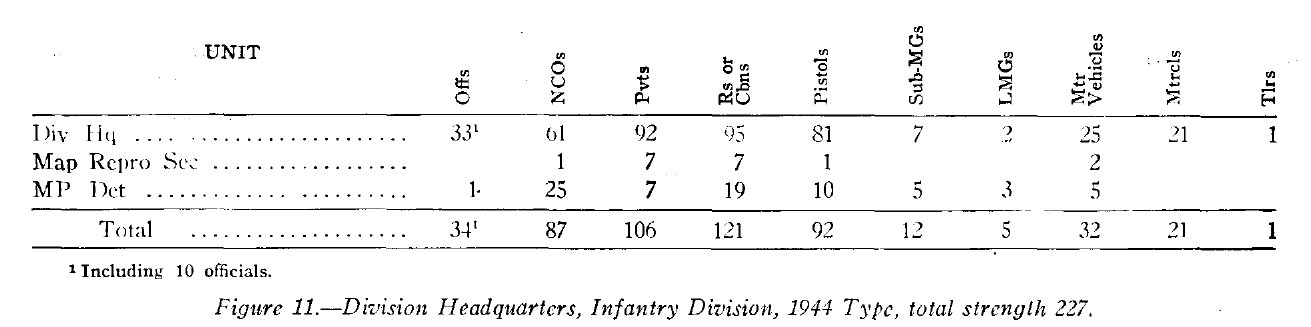
| Division headquarters | 227Infantry Division, 1944 Type Handbook on German Military Forces (TM-E 30-451) (1945), p. 99“Figure Il.—Division Headquarters, Infantry Division, 1944 Type, tofal strcngtlz 227.” |
Weapons and equipment
Allotments as the documents printed them, each with its sentence and page. Values run from the earliest source to the latest.
| Item | Value as printedSource and quoted text |
|---|---|
| Light machine guns per rifle company | 13After May 1944 (from 16) Handbook on German Military Forces (TM-E 30-451) (1945), p. 95“light machine guns per rifle company from 16 to 13” |
| Machine guns (division) | unchangedCompared with Old Type Handbook on German Military Forces (TM-E 30-451) (1945), p. 95“the number of machine guns kept unchanged” |
What was reported, and when
Handbook lists the type at 12,500 men and notes it is believed superseded by Infantry Division, Type 1945.
Handbook on German Military Forces (TM-E 30-451) (1945), p. 91
Renamed Infantry Division, 1944 Type after further economies, including squad strength cut from ten to nine.
Handbook on German Military Forces (TM-E 30-451) (1945), p. 95
Infantry regiments reduced from three battalions to two; rifle platoons reduced from four squads to three.
Handbook on German Military Forces (TM-E 30-451) (1945), p. 95
Read it against another formation
A side-by-side comparison is planned. Until then, the strength and equipment tables use the same layout on every formation page, so two pages can be read against each other.