Soviet Rifle Division (1945)
Soviet Union, division, 1945, as described in 2 wartime documents.
The sources call it the “Rifle division”. Also written as Red Army rifle division, Red Army Rifle Division, Rifle Division.
Key figures
The latest figure printed for each. Select one to see every value, its quoted sentence and its page.
- Personnel (standard table of organization, late war)
- 9,619Standard rifle division TO&E (fig. 3), 1946 source
- Personnel (1941 reductions)
- approximately 10,000Basic size set July 1941, 1946 source, 3 values
- Personnel (emergency reduced division, TO&E of November 1943)
- 5,000 to 8,000Reduced rifle division; size set by Army Group or independent army commander, 1946 source
- Antiaircraft machine guns
- 18 x 12.7-mm antiaircraft machine gunsCompany reintroduced summer 1944, 1946 source
What the sources say
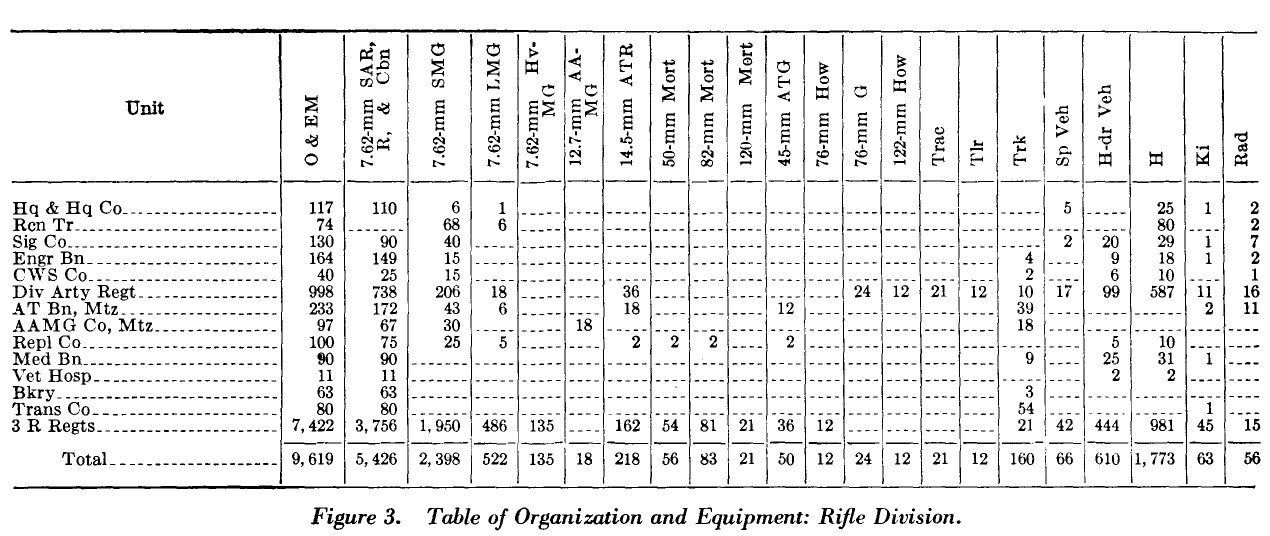
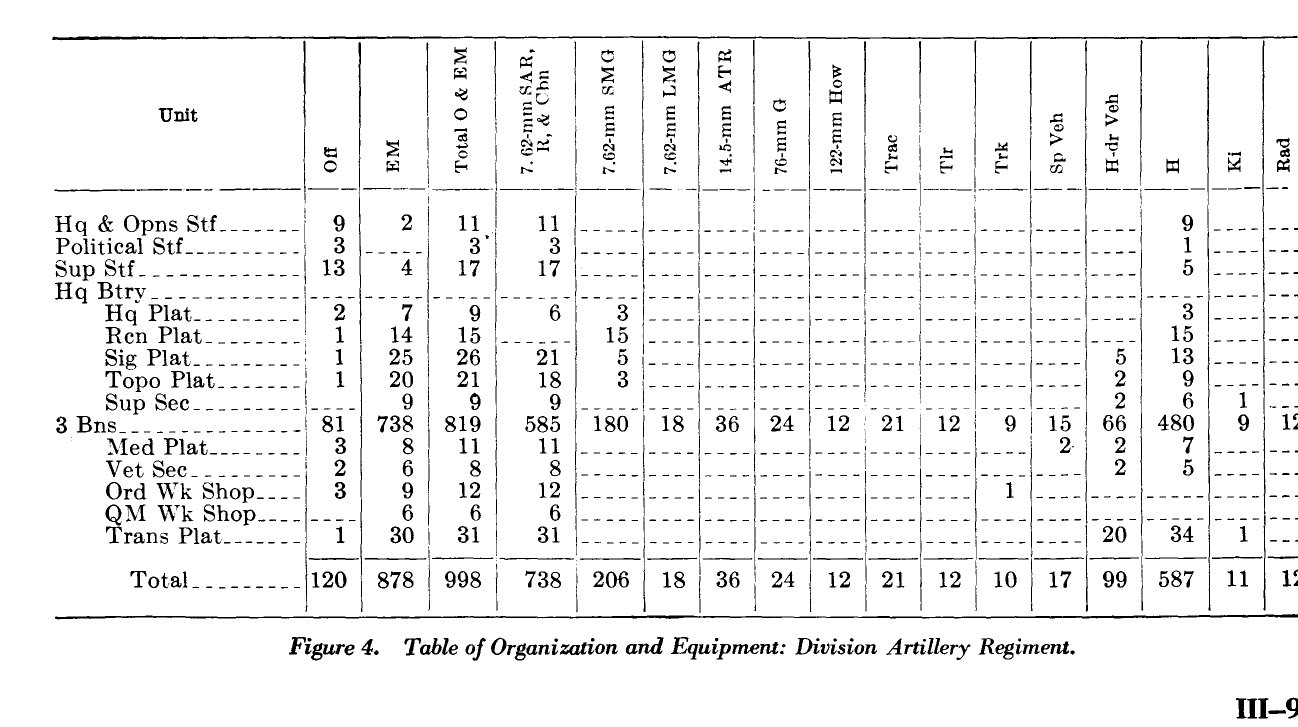
The US War Department handbook TM 30-430 (March 1946) gives the late-war Red Army rifle division a standard table of organization totaling 9,619 personnel [1]. The division was built around three rifle regiments, each with three rifle battalions, and had supporting units of artillery, antitank, antiaircraft, engineer, signal, reconnaissance and chemical warfare troops [1]. Its mixed divisional artillery regiment of 998 men fielded 122-mm howitzers and 76-mm guns, and the divisional antitank battalion used 45-mm guns [1].
Size changed during the war. In April 1941 the division was cut from 18,841 to 14,454 men, and a basic size of about 10,000 was set in July 1941 [1]. Emergency flexible tables of November 1943 produced reduced divisions of 5,000 to 8,000 men, sized by the commander of an army group or independent army [1]. Compared with the US infantry division, the Red Army rifle division was 4,424 men smaller, and its supporting arms and services made up 26 and 12 percent of its strength against 36 and 21 percent in the US division [1].
The division was horse drawn, though complete motorization would take 1,200 trucks [1]. The 1945 tactics chapter puts the organic radio allotment at a little over 10 percent of the US infantry division, with radio used as an auxiliary to wire [2].
Organization
19 units as the documents lay them out. The number before a unit is how many of it sit in the unit above; the figure on the right is its strength as printed (per unit). Select a unit with an arrow to open or close what is under it. Numbers in brackets refer to the sources below.
3 ×Rifle company
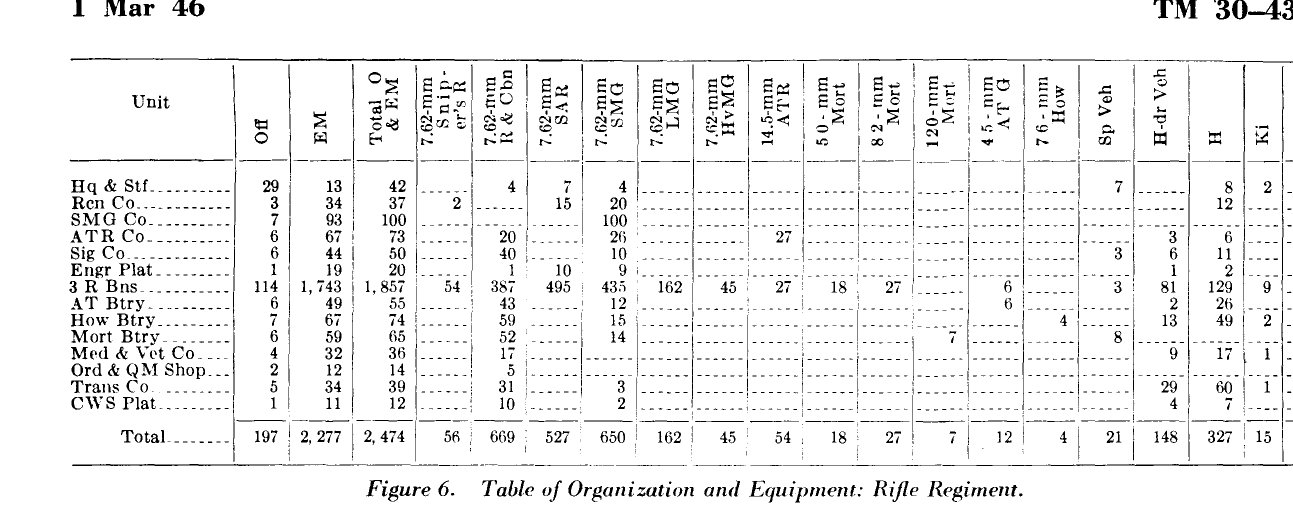
[1] p. 16 “consists of headquarters, three rifle companies, antitank rifle platoon, mortar company, machine gun company, antitank gun platoon, and a medical unit”
1 ×Antitank rifle platoon
[1] p. 16 “consists of headquarters, three rifle companies, antitank rifle platoon, mortar company, machine gun company, antitank gun platoon, and a medical unit”
1 ×Mortar company
[1] p. 16 “consists of headquarters, three rifle companies, antitank rifle platoon, mortar company, machine gun company, antitank gun platoon, and a medical unit”
1 ×Machine gun company
[1] p. 16 “consists of headquarters, three rifle companies, antitank rifle platoon, mortar company, machine gun company, antitank gun platoon, and a medical unit”
1 ×Antitank gun platoon
[1] p. 16 “consists of headquarters, three rifle companies, antitank rifle platoon, mortar company, machine gun company, antitank gun platoon, and a medical unit”
1 ×Medical unit
[1] p. 16 “consists of headquarters, three rifle companies, antitank rifle platoon, mortar company, machine gun company, antitank gun platoon, and a medical unit”
1 ×Submachine gun company
[1] p. 15 “submachine gun company of 100 men”
1 ×Divisional artillery regiment (mixed field artillery)
998
[1] p. 14 “The mixed artillery regiment includes 998 officers and enlisted men”
1 ×Antiaircraft machine gun company
[1] p. 14 “is armed with eighteen 12.7-mm antiaircraft”
Original charts and tables
The figures the outline and tables on this page were read from, cropped from the scans. Select one to open it at full size; the small print is legible there.
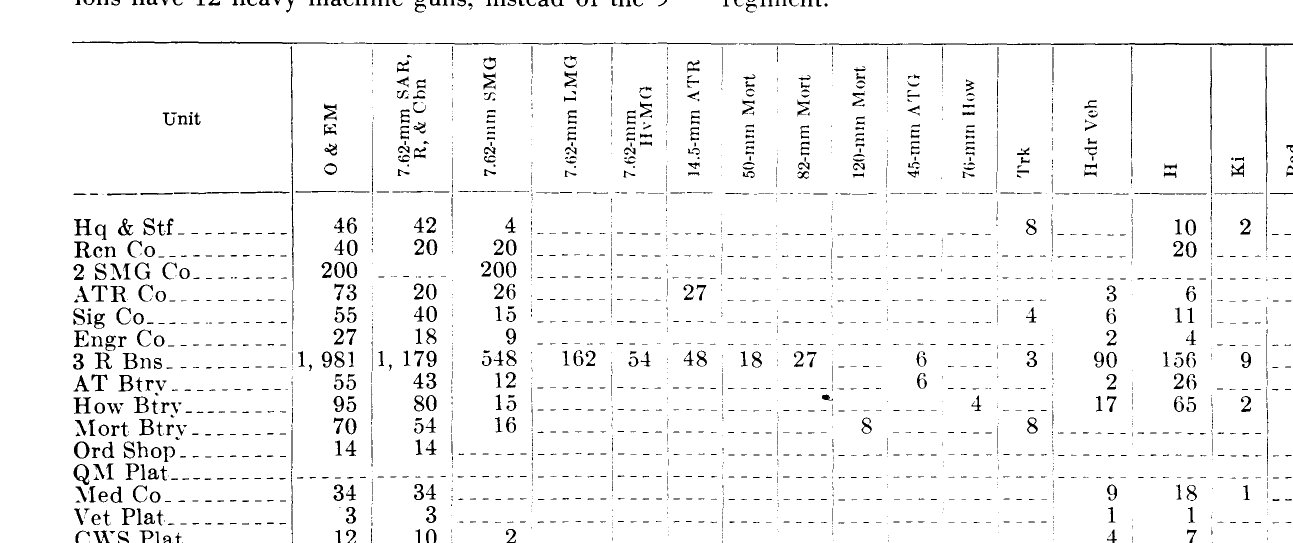
Strength, source by source
Personnel figures as the documents printed them, each with its sentence and page. Values run from the earliest source to the latest. 1 figure changed over time, as new models appeared and intelligence improved.
| Strength | Value as printedSource and quoted text |
|---|---|
| Personnel (standard table of organization, late war) | 9,619 (9619)Standard rifle division TO&E (fig. 3) TM 30-430 Handbook on USSR Military Forces, Chapter III: Field Organization (1946), p. 14“TotaL … 9,619” |
| Personnel (1941 reductions)Changed over time | 18,841 (18841)Before April 1941 reduction TM 30-430 Handbook on USSR Military Forces, Chapter III: Field Organization (1946), p. 9“In April 1941, it was reduced from 18,841 to 14,454 officers and enlisted men.” 14,454 (14454)After April 1941 reduction TM 30-430 Handbook on USSR Military Forces, Chapter III: Field Organization (1946), p. 9“In April 1941, it was reduced from 18,841 to 14,454 officers and enlisted men.” approximately 10,000 (10000)Basic size set July 1941 TM 30-430 Handbook on USSR Military Forces, Chapter III: Field Organization (1946), p. 9“Its basic size of approximately 10,000 was determined in July 1941.” |
| Personnel (emergency reduced division, TO&E of November 1943) | 5,000 to 8,000Reduced rifle division; size set by Army Group or independent army commander TM 30-430 Handbook on USSR Military Forces, Chapter III: Field Organization (1946), p. 15“The actual size of the division ranged from 5,000 to 8,000 officers and enlisted men.” |
| Personnel compared with US infantry division | 4,424 smaller than the U.S. infantry divisionCompared with the US infantry division TM 30-430 Handbook on USSR Military Forces, Chapter III: Field Organization (1946), p. 13“Although the personnel strength of the Red Army rifle division is 4,424” |
Weapons and equipment
Allotments as the documents printed them, each with its sentence and page. Values run from the earliest source to the latest.
| Item | Value as printedSource and quoted text |
|---|---|
| Divisional artillery weapons | 122-mm howitzers and 76-mm guns (mixed field artillery regiment)Late-war TO&E TM 30-430 Handbook on USSR Military Forces, Chapter III: Field Organization (1946), p. 14“It is armed with 122-howitzers and 76-mm” |
| Divisional artillery transport | Horse drawn, except 122-mm howitzers (tractor drawn) and ammunition trucks (122 mm)Late-war TO&E TM 30-430 Handbook on USSR Military Forces, Chapter III: Field Organization (1946), p. 14“the regiment is horse drawn” |
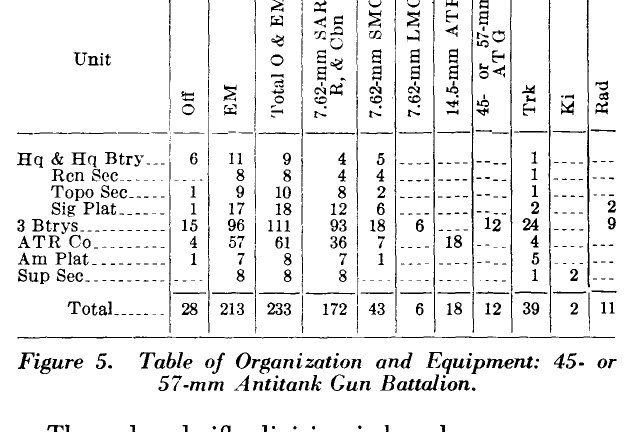
| Divisional antitank guns | 45-mm antitank guns, four per firing battery, three firing batteries (45 mm)Late-war TO&E; 57-mm or 76-mm guns substituted in the last year of the war TM 30-430 Handbook on USSR Military Forces, Chapter III: Field Organization (1946), p. 14“each with four 45-mm antitank guns” |
| Antiaircraft machine guns | 18 x 12.7-mm antiaircraft machine guns (18)Company reintroduced summer 1944 TM 30-430 Handbook on USSR Military Forces, Chapter III: Field Organization (1946), p. 14“is armed with eighteen 12.7-mm antiaircraft” |
| Trucks for complete motorization | 1,200 trucks (1200)Full motorization of the division TM 30-430 Handbook on USSR Military Forces, Chapter III: Field Organization (1946), p. 14“The Red Army rifle division can be completely motorized by the addition of 1,200 trucks.” |
| Radios (compared with US infantry division) | a little over 10 percent of the US infantry division allotmentOrganic allotment; radio used as an auxiliary to wire TM 30-430 Handbook on USSR Military Forces, Chapter V: Tactics (1945), p. 44“The organic allotment of radios in a Soviet rifle division is a little over 10 percent” |
What was reported, and when
Reduced from 18,841 to 14,454 officers and enlisted men; the basic size of about 10,000 was set in July 1941.
TM 30-430 Handbook on USSR Military Forces, Chapter III: Field Organization (1946), p. 9
Emergency flexible tables of organization and equipment produce reduced rifle divisions of 5,000 to 8,000 men.
TM 30-430 Handbook on USSR Military Forces, Chapter III: Field Organization (1946), p. 15
The divisional antiaircraft machine gun company was reintroduced into the rifle division.
TM 30-430 Handbook on USSR Military Forces, Chapter III: Field Organization (1946), p. 14
Read it against another formation
A side-by-side comparison is planned. Until then, the strength and equipment tables use the same layout on every formation page, so two pages can be read against each other.
Sources
- [1]TM 30-430 Handbook on USSR Military Forces, Chapter III: Field Organization (1946). Pages cited: 6, 9, 13, 14, 15, 16. Not on this site yet; links go to the document on the University of Nebraska–Lincoln DigitalCommons.
- [2]TM 30-430 Handbook on USSR Military Forces, Chapter V: Tactics (1945). Pages cited: 44, 119. Not on this site yet; links go to the document on the University of Nebraska–Lincoln DigitalCommons.