Panzer III
Panzerkampfwagen III (Pz.Kpfw. III, Sd.Kfz. 141)
Wartime US and British reports usually called it the “Mark III”.
Medium tank, Germany, as described in 13 wartime documents.
Also written as Pz Kw III, Panzer Kraftwagen III, Pz Kw III (Sd Kfz 141), Sd. Kfz. 141/1, Pz. Kw. 3, Mk. III, Mk. 3.
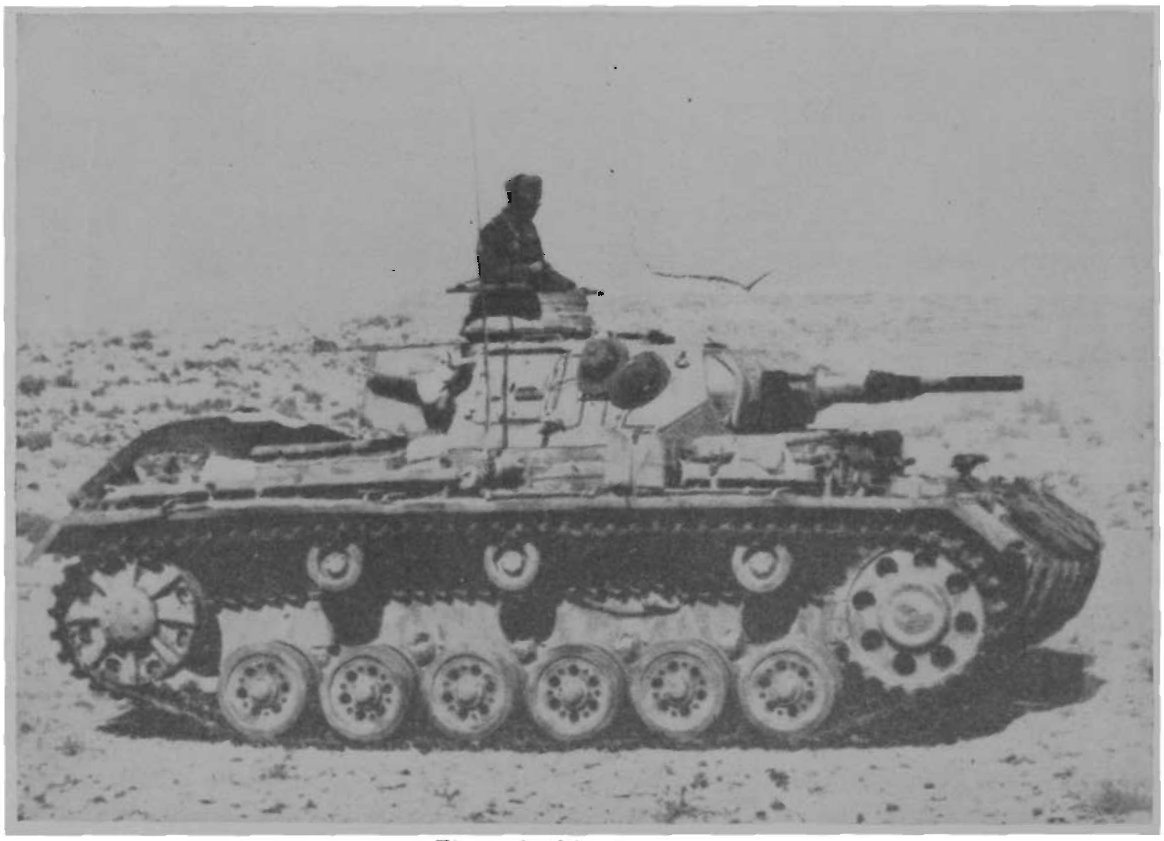
Key figures
The latest figure printed for each. Select one to see every value, its quoted sentence and its page.
- Crew
- 5 menModels L and M, 1945 source, 6 values
- Weight (combat)
- 24.6 tons (approximately)Models L and M, 1945 source, 8 values
- Length
- 17 feet 8 inchesModels L and M, 1945 source, 5 values
- Width
- 9 feet 9 inchesModels L and M, 1945 source, 5 values
- Height
- 8 feet 3 inchesModels L and M, 1945 source, 5 values
- Armor — hull sides
- 30 mmModels L and M, 1945 source, 7 values
- Armor — turret front
- 57 mmModels L and M, 1945 source, 2 values
- Armor — turret sides
- 1-1/4"test vehicle, 1944 source
What the sources say
The Panzerkampfwagen III (Sd Kfz 141) appears in these US and British manuals as a German medium tank, called a "light medium tank" of 18 to 20 tons in 1942 [4]. The June 1941 FM 30-42 knew little about it: a 37-mm gun, a crew of three or four, armor of 1 to 1.18 inches at most, and three possible suspension types [1]. Reports from North Africa in 1941-1942 described a 50-mm gun and 30 mm welded armor, with extra plates bolted onto the front [6][3]. By October 1942 the revised FM 30-42 gave a five-man crew, a 50-mm gun with 100 rounds, a V-12 engine and six small road wheels on torsion bars [5].
Through 1942 and 1943 the US view changed as more tanks were captured and tested. Tactical and Technical Trends identified three basic hull designs, from 30 mm all round to 50 mm front and rear, and models E to J [3]. The September 1943 handbook counted at least 10 models and called it the principal combat tank of the Panzer division, armed in turn with the 37-mm gun, the short 50-mm gun, the long 50-mm gun and a short 75-mm gun [8]. Later sources add spaced frontal armor (50 mm + 20 mm) and 5-mm skirting plates [7][11][13].
By March 1945 TM-E 30-451 called the Pz. Kpfw. III obsolete and rarely encountered, though its hull and suspension stayed in production as the carriage for self-propelled guns [13]. For Models L and M it gives 24.6 tons, the long 5 cm Kw.K. 39 (L/60) and a 296 hp Maybach HL 120 TRM engine [13]. Weight estimates in these sources rise from 18 tons in 1941 [1] to about 24.6 tons in 1945 [13].
Specifications, source by source
Every figure as the document printed it, with the sentence it came from and a link to the page. Values run from the earliest source to the latest. 14 figures changed over time, as new models appeared and intelligence improved. On 5 attributes, sources from the same year disagree; those rows are marked in amber.
| Attribute | Value as printedSource and quoted text |
|---|---|
| Designation / specification number | Sd Kfz 141 FM 30-42 (1942), p. 56“PZ KW III (PANZER KRAFTWAGEN III) (SD KFZ 141),” Sd.Kfz. 141 TM-E 30-451 Handbook on German Military Forces (1 September 1943), p. 134“(1) Pz.Kw. Ill (Sd.Kfz. 141).—The basic design of this tank” Sd. Kfz. 141/1Models L and M TM-E 30-451 Handbook on German Military Forces (1 March 1945), p. 388“Specification number ...Sd. Kf.:. 141/1.” |
| Models (Ausführungen) reported | at least five models designated E, F, G, H, J Tactical and Technical Trends Nos. 1-20 (June 1942 - March 1943), p. 344“five m o d e ls designate d ' E *, *F \ *G , * HJ, and * j” at least 10 different models TM-E 30-451 Handbook on German Military Forces (1 September 1943), p. 134“At least 10 different models” Model M examined in North Africa, April 1943 Intelligence Bulletin Vol. 2 No. 1 (September 1943), p. 67“In April 1943, a Pz. Kw. 3 (Model M) examined in North Africa” |
| Crew | Three or four (driver and two gunners) FM 30-42 Identification of Foreign Armored Vehicles (20 June 1941 ed.), p. 40“1. Crew: Three or four (driver and. two gunners).” 4 MID Special Bulletin No. 36: The Battle of Salum, June 15-17, 1941, p. 24“Mk. I Mk.II lie. Ill Mk.IV Weight 6 tons 9 tons 18-20 tons 22 tons Crew 2 3 4 5” Five (driver, hull gunner and radio operator, commander, gunner, and a loader) FM 30-42 (1942), p. 56“1. Crew: Five (driver, hull gunner and” 5 Pocket Book of the German Army 1943 (British War Office, CIGS), p. 141“Crew... 3 5 5 5” 5 menModels L and M TM-E 30-451 Handbook on German Military Forces (1 March 1945), p. 388“Crew 5 men.” |
| Weight (combat)Changed over time | 18 tons; 16 tons metric (16 t) FM 30-42 Identification of Foreign Armored Vehicles (20 June 1941 ed.), p. 40“10. Weight: 18 tons; 16 tons metric.” 18-20 tons MID Special Bulletin No. 36: The Battle of Salum, June 15-17, 1941, p. 24“Mk. I Mk.II lie. Ill Mk.IV Weight 6 tons 9 tons 18-20 tons 22 tons Crew 2 3 4 5” 18 to 20 tons Intelligence Bulletin Vol. 1 No. 1 (September 1942), p. 11“the Mark III, a light medium tank of 18 to 20 tons” in action: 19 tons 5 hundredweight (unladen 18 tons 10 hundredweight) (19.6 t (if long tons)) FM 30-42 (1942), p. 56“hundredweight; in action: 19 tons 5” 22 tons Pocket Book of the German Army 1943 (British War Office, CIGS), p. 141“‘Weight Ob tons 22 tons 23 tons . 56 tons” 22 tons (approx.) Vulnerability Tests of German Tanks PzKw III, IV, VI (19 July 1944), p. 6“22 tons 1 8 ft. 9 ft., 6 ins. 8 ft., 1 in.” 24.7 tonswith 50-mm long-barreled gun Company Officer's Handbook of the German Army (MID Special Series No. 22, 31 March 1944), p. 75“(Weight, 24.7 tons;” 24.6 tons (approximately)Models L and M TM-E 30-451 Handbook on German Military Forces (1 March 1945), p. 388“Weight in action 24.6 ton- (approximately).” |
| LengthChanged over time | 16 feet 5 inches (5.00 m) FM 30-42 Identification of Foreign Armored Vehicles (20 June 1941 ed.), p. 40“Length: 16 feet 5 inches.” 18 feet (5.49 m) FM 30-42 (1942), p. 56“Length: 18 feet.” 17 ft 9 in (5.41 m) Pocket Book of the German Army 1943 (British War Office, CIGS), p. 141“1. Length... 15 ft 3 in 17 it 9in 19 ft 4.in 20 ft 6 in” 18 ft. (5.49 m) Vulnerability Tests of German Tanks PzKw III, IV, VI (19 July 1944), p. 6“22 tons 1 8 ft. 9 ft., 6 ins. 8 ft., 1 in.” 17 feet 8 inches (5.38 m)Models L and M TM-E 30-451 Handbook on German Military Forces (1 March 1945), p. 389“Dimensions, Length.. . .17 feet 8 inches.” |
| WidthChanged over time | 7 feet 6 inches (2.29 m) FM 30-42 Identification of Foreign Armored Vehicles (20 June 1941 ed.), p. 40“Width: 7 feet 6 inches.” 9 feet 6 inches (2.90 m) FM 30-42 (1942), p. 56“Width: 9feet 6 inches.” 9 ft 8 in (2.95 m) Pocket Book of the German Army 1943 (British War Office, CIGS), p. 141“2. Width . 7ft4in 29 ft 8 in 9 ft 7in” 9 ft., 6 ins. (2.90 m) Vulnerability Tests of German Tanks PzKw III, IV, VI (19 July 1944), p. 6“22 tons 1 8 ft. 9 ft., 6 ins. 8 ft., 1 in.” 9 feet 9 inches (2.97 m)Models L and M TM-E 30-451 Handbook on German Military Forces (1 March 1945), p. 389“Width 9 feet 9 inches.” |
| HeightChanged over time | 7 feet 6 inches (2.29 m) FM 30-42 Identification of Foreign Armored Vehicles (20 June 1941 ed.), p. 40“Height: 7 feet 6 inches.” 8 feet 1 inch (2.46 m) FM 30-42 (1942), p. 56“Height: 8feet 1 inch.” 8 ft 3 in (2.51 m) Pocket Book of the German Army 1943 (British War Office, CIGS), p. 141“3. Height oe! 6 ft 6in 8 ft 3in 8 it 6in . 9 ft 6in” 8 ft., 1 in. (2.46 m) Vulnerability Tests of German Tanks PzKw III, IV, VI (19 July 1944), p. 6“22 tons 1 8 ft. 9 ft., 6 ins. 8 ft., 1 in.” 8 feet 3 inches (2.51 m)Models L and M TM-E 30-451 Handbook on German Military Forces (1 March 1945), p. 389“Height … 8 feet 3 inches.” |
| Main armamentSame-year sources disagree | One 37-mm gun (37 mm) FM 30-42 Identification of Foreign Armored Vehicles (20 June 1941 ed.), p. 40“2. Armament: One 37-mm gun and one machine gun coaxially mounted;” one 50-mm. gun (50 mm) MID Special Bulletin No. 36: The Battle of Salum, June 15-17, 1941, p. 24“one 50-mm. gun 2 machine guns one 75-mm. gun” 37-mm gun, being replaced by 50-mm Tactical and Technical Trends Nos. 1-20 (June 1942 - March 1943), p. 47“the 3 7 - m m. g un in the M a rk I II tank,” 37-mm originally; 50-mm substituted; many now with long-barrelled type Tactical and Technical Trends Nos. 1-20 (June 1942 - March 1943), p. 343“( m a ny ar e n ow mounting the long-barrelle d t y p e ),” Formerly one 37-mm gun; in most cases replaced by a 50-mm Intelligence Bulletin Vol. 1 No. 1 (September 1942), p. 14“machine guns, but in most cases the 37-mm. has been replaced by a 50-mm.” One 50-mm (Kwk) gun (50 mm) FM 30-42 (1942), p. 56“2. Armament: One 50-mm (Kwk)” one 50 mm rapid fire cannon (50 mm) AA Command Intelligence Circular, 13 November 1942, p. 76“The Armament is one 50 mm, rapid fire cannon in.the power or hand operated turret” One long 5-cm KwK 39 or one short 7.5-cm KwK Pocket Book of the German Army 1943 (British War Office, CIGS), p. 141“One long 5-cm (1-97-in)” 37-mm gun (37 mm)four earlier models TM-E 30-451 Handbook on German Military Forces (1 September 1943), p. 134“The four earlier models of this tank were armed with a 37-mm gun” short-barreled 50-mm electrically-fired tank gun (50 mm)next three models TM-E 30-451 Handbook on German Military Forces (1 September 1943), p. 135“the 37-mm gun was replaced by the short-barreled 50-mm electrically-fired tank gun” long-barreled 50-mm gun with a higher muzzle velocity; or short-barreled 75-mm gunlate models TM-E 30-451 Handbook on German Military Forces (1 September 1943), p. 135“the original 50-mm tank gun has been replaced by a long-barreled 50-mm gun with a higher muzzle velocity” One short-barreled 75-mm gun (75 mm) FM 30-40 Recognition Pictorial Manual on Armored Vehicles (sheet dated November 1943), p. 130“One short-barreled 75-mm = gun in turret.” one 50-mm long-barreled tank gun (5 cm Kw.K. 39) or one 75-mm short-barreled tank gun (7.5 cm Kw.K.) Company Officer's Handbook of the German Army (MID Special Series No. 22, 31 March 1944), p. 75“one 50-mm long-barreled tank gun (5 cm Kw.K. 39) or one 75-mm short-barreled tank gun (7.5 cm Kw.K.),” 50mm Gun KWK 39Models J-K Vulnerability Tests of German Tanks PzKw III, IV, VI (19 July 1944), p. 6“Tank Models, J-K-50mm Gun KWK 39.” 75mm Gun, KWK (75 mm)Models L-N Vulnerability Tests of German Tanks PzKw III, IV, VI (19 July 1944), p. 6“Tank Model, L-N-75mm Gun, KWK.” One 5 cm Kw.K. 39Models L and M TM-E 30-451 Handbook on German Military Forces (1 March 1945), p. 388“mounted in turret) . . .One 5 CU‘ Kw.K. 39” long-barreled 5 cm Kw.K. 39 (L/60), which in 1942 displaced the shorter 5 cm Kw.K. (L/32) TM-E 30-451 Handbook on German Military Forces (1 March 1945), p. 388“armed with the long- barreled 5 cm Kw.K. 39 (L/60), which in 1942 displaced the shorter 5 cm Kw.K. (L/32).” |
| Secondary armament | one machine gun coaxial; one machine gun on hull FM 30-42 Identification of Foreign Armored Vehicles (20 June 1941 ed.), p. 40“coaxially mounted; one machine gun on hull.” 1 Spandau light machine gun coaxial; one machine gun in hull firing forward FM 30-42 (1942), p. 56“gun and I Spandau light machine gun,” one co-axial Spandau 7.91 mm light MG; one Spandau 7.91 mm light MG in hull superstructure AA Command Intelligence Circular, 13 November 1942, p. 76“one: co-axial SPANDAU 7,91 mm. light machine-gun; and one independent SPANDAU 7*91 mm, light machine gun mounted in the hull superstructure” two machine guns in turret and one in hullfour earlier models TM-E 30-451 Handbook on German Military Forces (1 September 1943), p. 134“armed with a 37-mm gun and two machine guns in the turret and” one machine gun in turret; hull machine gun retained50-mm models TM-E 30-451 Handbook on German Military Forces (1 September 1943), p. 135“one machine gun (instead of two) was mounted in the turret (fig. 91). The machine gun in the forward part of the hull was retained.” one 7.92-mm MG in turret, one 7.92-mm MG in hull Company Officer's Handbook of the German Army (MID Special Series No. 22, 31 March 1944), p. 75“one 7.92-mm machine gun in turret, and one 7.92-mm machine gun in hull.)” Two M.G. 34's, one coaxial, one in hull (10.36 m) Vulnerability Tests of German Tanks PzKw III, IV, VI (19 July 1944), p. 6“Two M.G. 34's, one mounted coaxially, one mounted in hull.” One M.G.34 coaxial; one M.G.34 in hullModels L and M TM-E 30-451 Handbook on German Military Forces (1 March 1945), p. 389“In hull One M.G.34.” |
| Ammunition stowage | 100 rounds 50-mm (AP, HE); MG ammunition in belts of 75 rounds FM 30-42 (1942), p. 56“3. Ammunition: 100 rounds 50-mrn” |
| Armor — general / maximumChanged over time | Thickest known, 1 inch to 1.18 inches (25-30 mm) FM 30-42 Identification of Foreign Armored Vehicles (20 June 1941 ed.), p. 40“4. Armor, thickness: Thickest known, 1 inch to 1.18 inches.” 30 mm all round, except top of rear engine compartment 20 mm (all welded) (30 mm) AA Command Intelligence Circular, 13 November 1942, p. 76“The armour (all welded) is 30 mm, all round, except the top of the rear engine compartment, which is 20 mm.” type 1: 30 mm (1.18 in) all around (30 mm)type 1 (incl. Model G) Tactical and Technical Trends Nos. 1-20 (June 1942 - March 1943), p. 343“t he firs t h as an armo r b a s is of 30 mm ( 1 . 18 in) all around.” type 2: 30 mm all around with additional 30-mm plates bolted on (30 mm + 30 mm)type 2 Tactical and Technical Trends Nos. 1-20 (June 1942 - March 1943), p. 343“a d d i t i o n al 30-mm plate s bolted o n.” |
| Armor — hull frontSame-year sources disagree | 2.76 in. (70 mm) MID Special Bulletin No. 36: The Battle of Salum, June 15-17, 1941, p. 24“Front Armor .71 in. 1.58 in. 2.76 in. 2.36 xn.” 50 mm (front and rear) (50 mm)type 3 (incl. Model J) Tactical and Technical Trends Nos. 1-20 (June 1942 - March 1943), p. 343“The third t y pe h as 5 0 - mm a r m or o n the front a nd rear ,” original 30 mm plus bolted 30 or 32 mm face-hardened plates: total 60 to 62 mm (60-62 mm)reinforced original type Tactical and Technical Trends Nos. 1-20 (June 1942 - March 1943), p. 244“T h is tota l thickness of 60 to 62 mm” single thickness of 50 mm, face-hardened (50 mm)new type Tactical and Technical Trends Nos. 1-20 (June 1942 - March 1943), p. 244“The n ew Mark i n tan k ha s a s i n g le thicknes s of 5 0 - mm armo r” 1.1 inch (28 mm) FM 30-42 (1942), p. 56“Front: 1.1 inch.” 50 mm + 20 mm (spaced) (50 + 20 mm) Pocket Book of the German Army 1943 (British War Office, CIGS), p. 141“50 mm-+20 mm (spaced)” basic armor increased to 50 mm on the front and rear (50 mm)later models TM-E 30-451 Handbook on German Military Forces (1 September 1943), p. 135“ness of the basic armor to 50 mm on the front and rear.” 30mm Homo / 50mm F.H. (by model) Vulnerability Tests of German Tanks PzKw III, IV, VI (19 July 1944), p. 6“Front 30mm Homo 50mm F.H. Sides 30mm” lower hull front 2" + 1-1/4" (51 + 32 mm)test vehicle Vulnerability Tests of German Tanks PzKw III, IV, VI (19 July 1944), p. 7“LOWER HULL-FRONT 2" +• I- 1/4" THICK” nose plate 50 mm (50 mm)Models L and M TM-E 30-451 Handbook on German Military Forces (1 March 1945), p. 388“I~riml nose plate..SO mm.” glacis plate 25 mm (25 mm)Models L and M TM-E 30-451 Handbook on German Military Forces (1 March 1945), p. 388“C,lnci\ Illate _..25 mm.” |
| Armor — superstructure frontSame-year sources disagree | extra 30 mm plate on front of superstructure; extra 40 mm plate on front of gun mounting (30 mm + 30 mm) AA Command Intelligence Circular, 13 November 1942, p. 76“Extra 40 mm, plate is bolted on the front of the gun mounting, and extra 30 mm, plate .on the front of the superstructure,” Upper structure: 1.1-inch plus 1.1-inch extra plate (28 + 28 mm) FM 30-42 (1942), p. 56“Upper structure: 1.1-inch plus 1.1-” 30mm Homo plus 32mm F.H.; 50mm plus 20mm F.H. spaced armor (by model) Vulnerability Tests of German Tanks PzKw III, IV, VI (19 July 1944), p. 6“30mm Homo plus 32mm F.H. 50mm plus 20mm F.H. spaced armor” driver's front plate 50 and 20 mm spaced armor (50 + 20 mm)Models L and M TM-E 30-451 Handbook on German Military Forces (1 March 1945), p. 388“Driver's front plate 50 antI 20 mm ,spaced armor.” |
| Armor — hull sidesChanged over time | 1.18 in. (30 mm) MID Special Bulletin No. 36: The Battle of Salum, June 15-17, 1941, p. 24“Side Armor .55 in. .59 in. 1.18 in. 1.58 in.” 30 mmtype 3 Tactical and Technical Trends Nos. 1-20 (June 1942 - March 1943), p. 343“w i th 30-mm armor on the sides .” 30-mm (1.1-inch) (30 mm) FM 30-42 (1942), p. 56“Sides: 30-mm (1.1-inch).” 30 mm Pocket Book of the German Army 1943 (British War Office, CIGS), p. 141“2. Sides : ismm . ~ 30 mm . ° 30 mm. 82 mm.” 30mm (30 mm) Vulnerability Tests of German Tanks PzKw III, IV, VI (19 July 1944), p. 6“Front 30mm Homo 50mm F.H. Sides 30mm” upper and lower hull side 1-1/4" (32 mm)test vehicle Vulnerability Tests of German Tanks PzKw III, IV, VI (19 July 1944), p. 7“UPPER HULL-SIDE 1-1/4" THICK” 30 mmModels L and M TM-E 30-451 Handbook on German Military Forces (1 March 1945), p. 388“Hull sides 30 mm.” |
| Armor — hull rearChanged over time | 50 mm (front and rear) (50 mm)type 3 Tactical and Technical Trends Nos. 1-20 (June 1942 - March 1943), p. 343“The third t y pe h as 5 0 - mm a r m or o n the front a nd rear ,” additional 30-mm plates on the front and rear (30 mm + 30 mm)type 2 Tactical and Technical Trends Nos. 1-20 (June 1942 - March 1943), p. 343“simila r a d d i t i o n al 30-mm plate s on the f r o nt and rear” basic armor increased to 50 mm on the front and rear (50 mm)later models TM-E 30-451 Handbook on German Military Forces (1 September 1943), p. 135“ness of the basic armor to 50 mm on the front and rear.” upper and lower hull rear 2" (51 mm)test vehicle Vulnerability Tests of German Tanks PzKw III, IV, VI (19 July 1944), p. 7“UPPER HULL-REAR 2" THICK” |
| Armor — turret frontChanged over time | 2" (51 mm)test vehicle Vulnerability Tests of German Tanks PzKw III, IV, VI (19 July 1944), p. 7“TURRET FRONT - 2" THICK” 57 mmModels L and M TM-E 30-451 Handbook on German Military Forces (1 March 1945), p. 388“Turret front 57 mm.” |
| Armor — turret sides | 1-1/4" (32 mm)test vehicle Vulnerability Tests of German Tanks PzKw III, IV, VI (19 July 1944), p. 7“TURRET-SIDE 1-1/4" THICK” |
| Armor — top / deckChanged over time | top of rear engine compartment 20 mm (20 mm) AA Command Intelligence Circular, 13 November 1942, p. 76“except the top of the rear engine compartment, which is 20 mm.” 12 mm Pocket Book of the German Army 1943 (British War Office, CIGS), p. 141“3. Top ‘10-15 mm 12 mm 12 mm 26 mm.” |
| Armor — skirting plates | 5-mm (0.2-inch) plates outside turret and suspension (5 mm) Company Officer's Handbook of the German Army (MID Special Series No. 22, 31 March 1944), p. 77“The Pz.Kpfw. III and IV now carry 5-mm (0.2-inch) plates outside their turrets and outside their suspension.” |
| Engine | V-12, 4-stroke; water-cooled FM 30-42 (1942), p. 56“Type: V-12, 4-stroke.” 300 hp 12 cyl petrol, water-cooled Pocket Book of the German Army 1943 (British War Office, CIGS), p. 141“300 hp 12 cyl petrol,” Maybach V-12 Vulnerability Tests of German Tanks PzKw III, IV, VI (19 July 1944), p. 6“Engine Maybach V-12” Maybach HL 120 TRM, gasolineModels L and M TM-E 30-451 Handbook on German Military Forces (1 March 1945), p. 389“Engine, Type Maybach HL 120 TRM.” |
| Horsepower | 300 (16.7 hp per ton) FM 30-42 Identification of Foreign Armored Vehicles (20 June 1941 ed.), p. 40“Horsepower: 300.Horsepower per ton: 16.7.” 265 FM 30-42 (1942), p. 56“Horsepower: 265.” 300 hp Pocket Book of the German Army 1943 (British War Office, CIGS), p. 141“300 hp 12 cyl petrol,” 296 HP at 3,000 rpmModels L and M TM-E 30-451 Handbook on German Military Forces (1 March 1945), p. 389“BHP 296 HP at 3,000 rpm.” |
| Transmission | Variorex gearbox (type 1); ordinary six-speed gearbox (types 2 and 3) Tactical and Technical Trends Nos. 1-20 (June 1942 - March 1943), p. 343“A n ordin- ary six-spee d g e ar b ox” Eight forward, two reverse FM 30-42 (1942), p. 56“16. Gear speeds and ratios: Eight for--” SSG77 Maybach synchromesh, six forward, one reverseModels L and M TM-E 30-451 Handbook on German Military Forces (1 March 1945), p. 389“Six forward speeds, one reverse.” |
| Maximum speed (road)Changed over time | Road: 28 miles per hour (45 km/h) FM 30-42 Identification of Foreign Armored Vehicles (20 June 1941 ed.), p. 40“Road: 28 miles per hour.” 28 miles per hour (45 km/h) Intelligence Bulletin Vol. 1 No. 1 (September 1942), p. 14“Its best possible speed is 28 miles per hour,” Maximum, 28 mph (45 km/h) FM 30-42 (1942), p. 56“13. Speed: Maximum, 28 mph.” 28 mph (45 km/h) Pocket Book of the German Army 1943 (British War Office, CIGS), p. 142“Max speed ~ 30mph_ 28 mph 25 mph 17 mph” 29 MPH (47 km/h) FM 30-40 Recognition Pictorial Manual on Armored Vehicles (sheet dated November 1943), p. 130“SPEED — 29 MPH” 28 miles per hour (45 km/h) Company Officer's Handbook of the German Army (MID Special Series No. 22, 31 March 1944), p. 75“maximum speed, 28 miles per hour;” 35 miles per hour (approximately) (56 km/h)Models L and M TM-E 30-451 Handbook on German Military Forces (1 March 1945), p. 389“speed … 35 miles per hour (approximately).” |
| Speed (cross-country) | 10 to 15 miles per hour (16-24 km/h)Models L and M TM-E 30-451 Handbook on German Military Forces (1 March 1945), p. 389“Cross-country speed. 10 to 15 miles per hour.” |
| Range / radius of actionChanged over time | Operating distance without refill: 113 miles (182 km) FM 30-42 (1942), p. 56“15. Operating dist:nce without refill:- armor piercing 40 and high explosive 25 113 miles.” 108 miles (roads), 58 miles (cross-country) (174 km / 93 km) Pocket Book of the German Army 1943 (British War Office, CIGS), p. 142“Radius of action—108 __ miles (roads), ‘58 miles (cross-country).” 102 miles (roads), 59 miles (cross-country) (164 km / 95 km) Vulnerability Tests of German Tanks PzKw III, IV, VI (19 July 1944), p. 6“3 ft. 3 ft. 27° 102 miles 59 miles” Range on roads 102 miles; cross-country 59 miles (164 km / 95 km)Models L and M TM-E 30-451 Handbook on German Military Forces (1 March 1945), p. 389“Range on roads ... I02 miles. Range cross-country. .59 miles.” |
| Trench crossingSame-year sources disagree | 8 ft 6 in (2.59 m) Pocket Book of the German Army 1943 (British War Office, CIGS), p. 142“1. Trench crossing 5 ft 6 in 8it6in 9 ft 10 ft” 7.0' (2.13 m) FM 30-40 Recognition Pictorial Manual on Armored Vehicles (sheet dated November 1943), p. 130“TRENCH — 7.0’” 7 ft., 6 ins. (2.29 m) Vulnerability Tests of German Tanks PzKw III, IV, VI (19 July 1944), p. 6“15 ins. 7 ft., 6 ins. 3 ft. 3 ft. 27°” 8 feet 6 inches (2.59 m)Models L and M TM-E 30-451 Handbook on German Military Forces (1 March 1945), p. 389“Trench crossing … 8 feet 6 inches.” |
| FordingSame-year sources disagree | 2 feet 11 inches (0.89 m) FM 30-42 Identification of Foreign Armored Vehicles (20 June 1941 ed.), p. 40“Fords streams 2 feet 11 inches deep.” 2 feet 7 inches (0.79 m) FM 30-42 (1942), p. 56“Fords streams 2 feet 7 inches deep.” 2 ft 9 in (0.84 m) Pocket Book of the German Army 1943 (British War Office, CIGS), p. 142“3. Water forded ... 2 ft 6in 2 ft 9in 2 ft 9in Submersible to 15 ft” 3.0' (0.91 m) FM 30-40 Recognition Pictorial Manual on Armored Vehicles (sheet dated November 1943), p. 130“FORD — 3.0’” 3 ft. (0.91 m) Vulnerability Tests of German Tanks PzKw III, IV, VI (19 July 1944), p. 6“15 ins. 7 ft., 6 ins. 3 ft. 3 ft. 27°” 2 feet 9 inches (0.84 m)Models L and M TM-E 30-451 Handbook on German Military Forces (1 March 1945), p. 389“Fording 2 feet 9 inches.” |
| Submersion (modified tanks) | maximum depth of 16 feet (Pz Kw 3's modified for submersion, Russia 1941) (4.9 m)specially modified tanks Intelligence Bulletin Vol. 2 No. 1 (September 1943), p. 67“which permitted submersion to a maximum depth of 16 feet.” |
| Step / vertical obstacleChanged over time | 1 foot 11 inches (0.58 m) FM 30-42 (1942), p. 56“Negotiates vertical obstacle 1 foot.” 2 ft (0.61 m) Pocket Book of the German Army 1943 (British War Office, CIGS), p. 142“2. Step... vee 2 ft 2 it 2 ft 2ft6in” 2.0' est. (0.61 m) FM 30-40 Recognition Pictorial Manual on Armored Vehicles (sheet dated November 1943), p. 130“STEP — 2.0’ EST.” 3 ft. (0.91 m) Vulnerability Tests of German Tanks PzKw III, IV, VI (19 July 1944), p. 6“15 ins. 7 ft., 6 ins. 3 ft. 3 ft. 27°” 2 feet (0.61 m)Models L and M TM-E 30-451 Handbook on German Military Forces (1 March 1945), p. 389“Step 2 feet.” |
| GradientChanged over time | 27° Vulnerability Tests of German Tanks PzKw III, IV, VI (19 July 1944), p. 6“15 ins. 7 ft., 6 ins. 3 ft. 3 ft. 27°” 30°Models L and M TM-E 30-451 Handbook on German Military Forces (1 March 1945), p. 389“Gradient … 30”.” |
| Ground clearanceChanged over time | 15 inches (0.38 m) FM 30-42 (1942), p. 56“Ground clearance: 15 inches.” 1 ft 3 in (0.38 m) Pocket Book of the German Army 1943 (British War Office, CIGS), p. 141“4, Belly clearance, ' Lfitlin 1ft3in 1 fit 3.in Lit4in” 15 ins. (0.38 m) Vulnerability Tests of German Tanks PzKw III, IV, VI (19 July 1944), p. 6“8 ft., 1 in. 15 ins. 7 ft., 6 ins.” 1 foot 2 inches (0.36 m)Models L and M TM-E 30-451 Handbook on German Military Forces (1 March 1945), p. 389“Ground clearance .. 1 foot 2 inches.” |
| Suspension | three types listed: six small independent bogie wheels; eight small bogie wheels; five large Christie-type bogie wheels FM 30-42 Identification of Foreign Armored Vehicles (20 June 1941 ed.), p. 40“(1) Six small independent bogie wheels with heavy rubber tires.” six small bogie wheels, three return rollers, front sprocket, rear idler; early five- and eight-wheel types probably prototypes Tactical and Technical Trends Nos. 1-20 (June 1942 - March 1943), p. 344“t he familia r s ix small b o g ie wheels w i th thre e r e t u rn rollers” six small bogie wheels sprung by torsion bars, hydraulic dampers front and rear, three return rollers, rear idler FM 30-42 (1942), p. 56“type has six small bogie wheels sprung” Six 20-in diameter rubber-tyred bogie-wheels sprung on torsion bars Pocket Book of the German Army 1943 (British War Office, CIGS), p. 142“Six 20-in diameterrubber- tyred bogie-wheels sprung on torsion bars.” six small evenly spaced bogie wheels; three track support rollers FM 30-40 Recognition Pictorial Manual on Armored Vehicles (sheet dated November 1943), p. 130“six small evenly” Six 20" diameter bogies (508 mm) Vulnerability Tests of German Tanks PzKw III, IV, VI (19 July 1944), p. 6“Suspension Six 20 diameter bogies” Six small rubber-tired bogie wheels on each side; torsion-bar suspensionModels L and M TM-E 30-451 Handbook on German Military Forces (1 March 1945), p. 389“Suspension: Six small rubber-tired bogie wheels on each side. Torsion-bar suspension.” |
| Turret traverse | 360° hand traverse; turret floor does not rotate FM 30-42 (1942), p. 56“5. Turret: 360 °handtraverse. Turret” power or hand operated turret with all-round traverse AA Command Intelligence Circular, 13 November 1942, p. 76“in.the power or hand operated turret with all-round traverse;” |
| Radio | Radio FM 30-42 Identification of Foreign Armored Vehicles (20 June 1941 ed.), p. 40“8. Communications: Radio.” W/T and R/T radio FM 30-42 (1942), p. 56“8. Communication: W/T and R/T” WT, RT, flag, intercom phone Pocket Book of the German Army 1943 (British War Office, CIGS), p. 142“‘WT, RT, flag, intercomn” |
What Allied intelligence knew, and when
MID's Salum study (June 1941 battle) credits the Mk III with a 50-mm gun, crew of 4, 18-20 tons and 2.76 in front armor (much higher than any other source here) with 1.18 in sides.
MID Special Bulletin No. 36: The Battle of Salum, June 15-17, 1941, p. 24
Earliest US identification sheet: a 37-mm gun, crew of three or four, armor 'thickest known' 1 to 1.18 in, 300 hp and 28 mph, with three possible suspension types listed.
FM 30-42 Identification of Foreign Armored Vehicles (20 June 1941 ed.), p. 40
A GHQ Middle East technical summary of 30 June 1941 (quoted in a November 1942 circular) describes a 50-mm gun and 30 mm welded armor all round, with extra 30 mm and 40 mm plates bolted on the front.
TTT No. 5 reports the 50-mm gun replacing the 37-mm in the Mark III as fast as materiel allows.
Tactical and Technical Trends Nos. 1-20 (June 1942 - March 1943), p. 47
The first Intelligence Bulletin calls the Mark III a 'light medium tank' of 18 to 20 tons whose 37-mm gun has in most cases been replaced by a 50-mm; top speed 28 mph.
TTT No. 8 reports British firing tests: the original 30 mm front reinforced with bolted 30-32 mm face-hardened plates (60-62 mm total) and a new model with single 50 mm face-hardened front armor.
Tactical and Technical Trends Nos. 1-20 (June 1942 - March 1943), p. 244
The revised FM 30-42 gives a five-man crew, a 50-mm gun with 100 rounds, 1.1 in (30 mm) armor plus a 1.1 in extra plate on the superstructure, a V-12 265 hp engine, 19 tons 5 cwt in action and torsion-bar suspension.
TTT No. 10 identifies three basic designs (30 mm all round; 30 mm plus bolted 30 mm plates; 50 mm front and rear) and models E, F, G, H and J, and warns that German armor figures are rounded (30 mm is often 32 mm).
Tactical and Technical Trends Nos. 1-20 (June 1942 - March 1943), p. 343
The British 1943 Pocket Book gives 22 tons, 50 mm + 20 mm spaced front armor, a long 5-cm KwK 39 or short 7.5-cm KwK, 300 hp and 28 mph.
Pocket Book of the German Army 1943 (British War Office, CIGS), p. 141
The Intelligence Bulletin describes Pz Kw 3's modified in 1941 for underwater crossings to 16 feet, and a Model M examined in North Africa in April 1943 that had been permanently modified for immersion.
TM-E 30-451 calls the Pz.Kw. III the principal combat tank of the Panzer division, with at least 10 models moving from the 37-mm gun to short and then long 50-mm guns and a short 75-mm, and armor raised to 50 mm front and rear.
TM-E 30-451 Handbook on German Military Forces (1 September 1943), p. 134
The FM 30-40 recognition sheet shows a short 75-mm gun version and summarizes the gun progression (short 50-mm, long 50-mm, then short and long 75-mm guns); speed 29 mph.
FM 30-40 Recognition Pictorial Manual on Armored Vehicles (sheet dated November 1943), p. 130
The Company Officer's Handbook gives 24.7 tons, 28 mph and a long 50-mm or short 75-mm gun, and notes 5-mm skirting plates on turret and suspension.
Company Officer's Handbook of the German Army (MID Special Series No. 22, 31 March 1944), p. 75
US vulnerability tests list 22 tons, 30 mm sides, and front armor of 30 mm up to 50 mm plus 20 mm spaced depending on model; the test vehicle had a 2 in turret front and 1-1/4 in sides.
Vulnerability Tests of German Tanks PzKw III, IV, VI (19 July 1944), p. 6
TM-E 30-451 calls the Pz. Kpfw. III obsolete and rarely encountered, surviving mainly as a self-propelled gun chassis; Models L and M are given as 24.6 tons, 5 cm KwK 39 L/60, 57 mm turret front, HL 120 TRM 296 hp.
TM-E 30-451 Handbook on German Military Forces (1 March 1945), p. 388
Illustrations
Cropped from wartime documents, including some not otherwise cited on this page. Each caption says what the picture is and links to the page it was printed on.
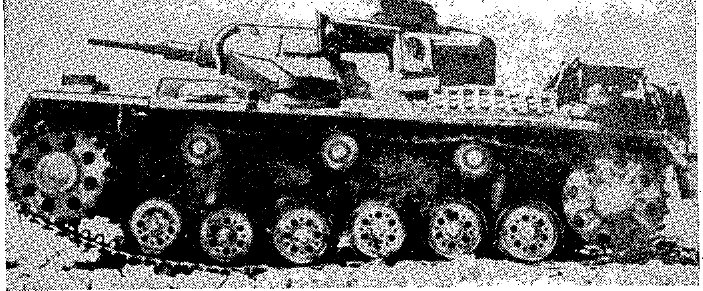
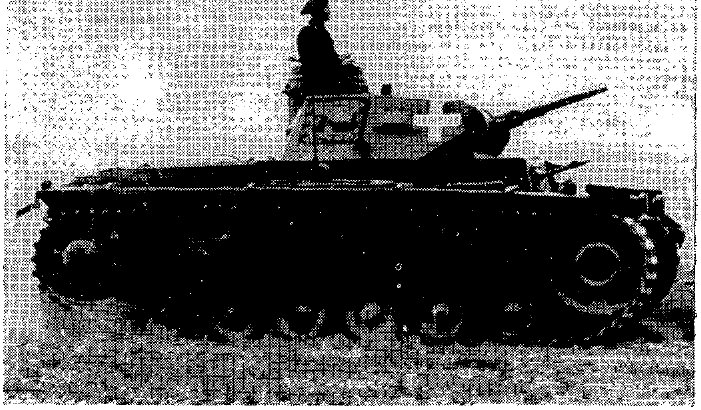
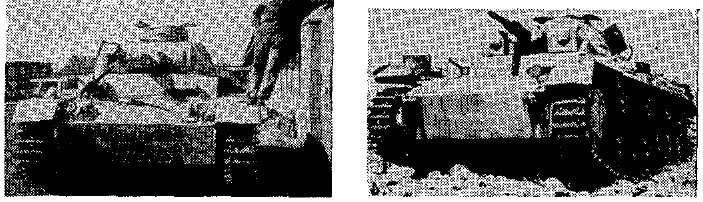
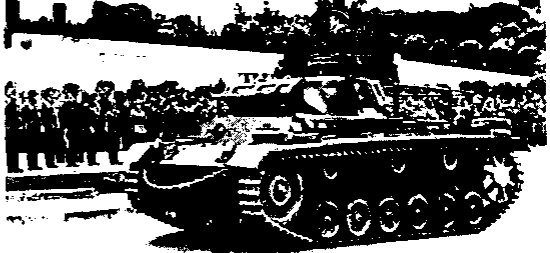
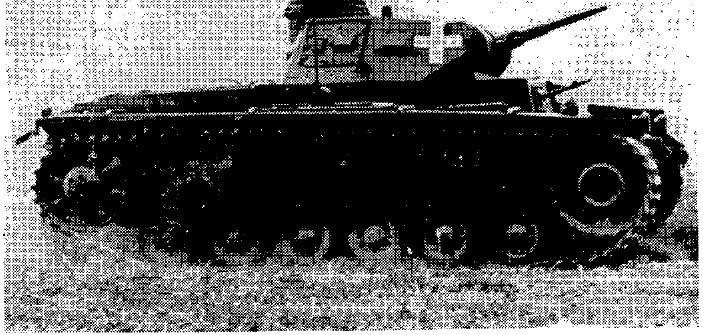
Cited pages published on this site, as scanned:
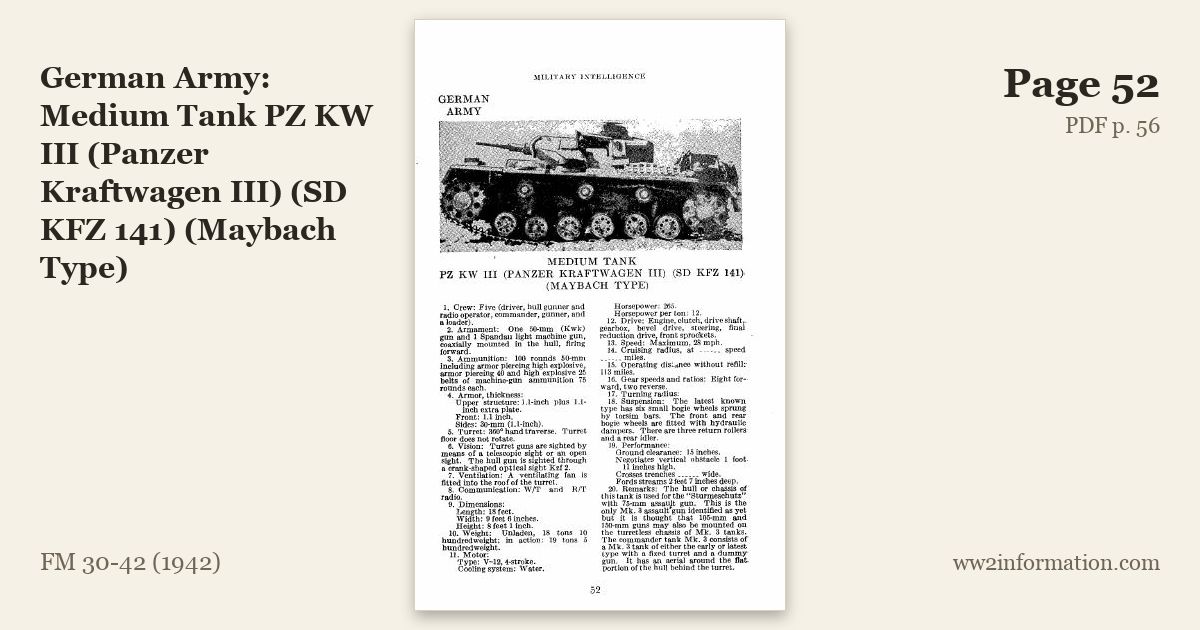
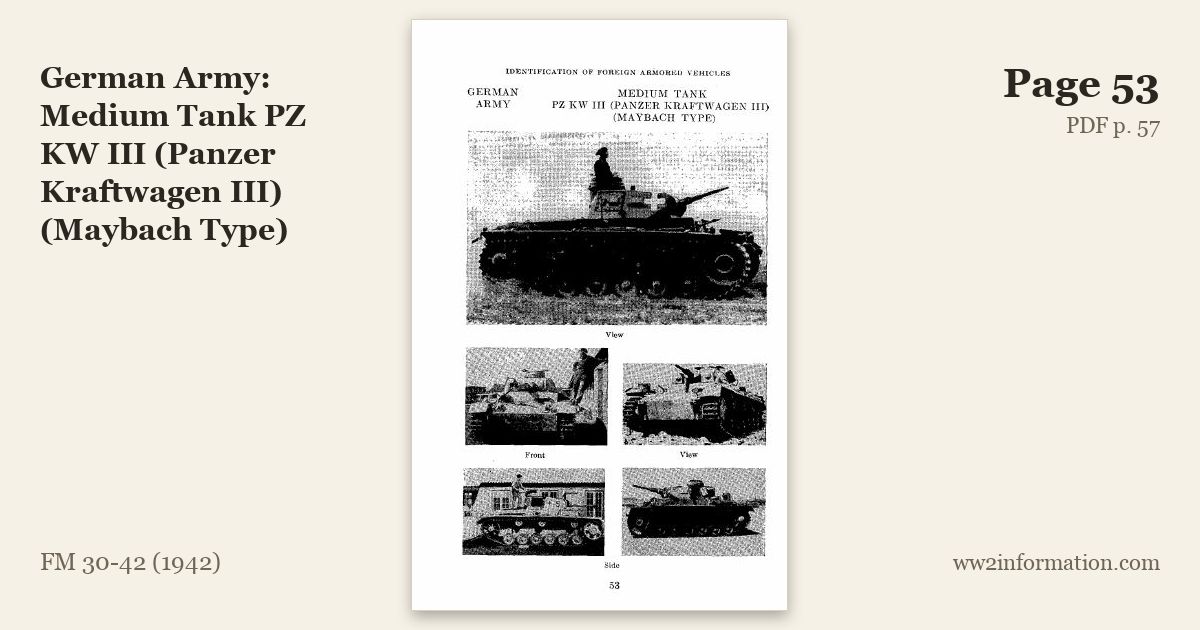
More vehicles
Sources
- [1]FM 30-42 Identification of Foreign Armored Vehicles (20 June 1941 ed.) (1941). Pages cited: 40, 41. Not on this site yet; links go to the page on the Internet Archive.
- [2]MID Special Bulletin No. 36: The Battle of Salum, June 15-17, 1941 (1941). Page cited: 24. Not on this site yet; links go to the document on the CGSC Digital Library.
- [3]Tactical and Technical Trends Nos. 1-20 (June 1942 - March 1943) (1942). Pages cited: 47, 56, 151, 244, 245, 343, 344. Not on this site yet; links go to the page on the Internet Archive.
- [4]Intelligence Bulletin Vol. 1 No. 1 (September 1942) (1942). Pages cited: 11, 14. Not on this site yet; links go to the page on the Internet Archive.
- [5]FM 30-42 Identification of Foreign Armored Vehicles: German, Japanese, Russian, and Italian (3 October 1942) (1942). Pages cited: 56, 57.
- [6]AA Command Intelligence Circular, 13 November 1942 (1942). Page cited: 76. Not on this site yet; links go to the document on the CGSC Digital Library.
- [7]Pocket Book of the German Army 1943 (British War Office, CIGS) (1943). Pages cited: 141, 142. Not on this site yet; links go to the document on the CGSC Digital Library.
- [8]TM-E 30-451 Handbook on German Military Forces (1 September 1943) (1943). Pages cited: 134, 135. Not on this site yet; links go to the page on the Internet Archive.
- [9]Intelligence Bulletin Vol. 2 No. 1 (September 1943) (1943). Pages cited: 63, 64, 67. Not on this site yet; links go to the page on the Internet Archive.
- [10]FM 30-40 Recognition Pictorial Manual on Armored Vehicles (sheet dated November 1943) (1943). Page cited: 130. Not on this site yet; links go to the page on the Internet Archive.
- [11]Company Officer's Handbook of the German Army (MID Special Series No. 22, 31 March 1944) (1944). Pages cited: 75, 77. Not on this site yet; links go to the page on the Internet Archive.
- [12]Vulnerability Tests of German Tanks PzKw III, IV, VI (19 July 1944) (1944). Pages cited: 6, 7. Not on this site yet; links go to the document on the CGSC Digital Library.
- [13]TM-E 30-451 Handbook on German Military Forces (1 March 1945) (1945). Pages cited: 368, 374, 388, 389, 540. Not on this site yet; links go to the page on the Internet Archive.