Pak 40
Panzerabwehrkanone 40
Wartime US and British reports usually called it the “75-mm antitank gun, model 40”.
Antitank gun, Germany, as described in 5 wartime documents.
Also written as 7.5 cm Pak 40, 75-mm (Pak 40), 75-mm antitank gun (7.5 cm Pak 40).
Key figures
The latest figure printed for each. Select one to see every value, its quoted sentence and its page.
- Caliber
- 75 mm (2.95 in bore)Bore 2.95 in, 1943 source
- Weight (firing position / traveling)
- 3,136 lbWeight in action, 1945 source, 3 values
- Muzzle velocity
- 3,250 ft/sAP 40 projectile, 1945 source, 4 values
- Projectile weight
- 15 lbAPCBC round, 1943 source
What the sources say
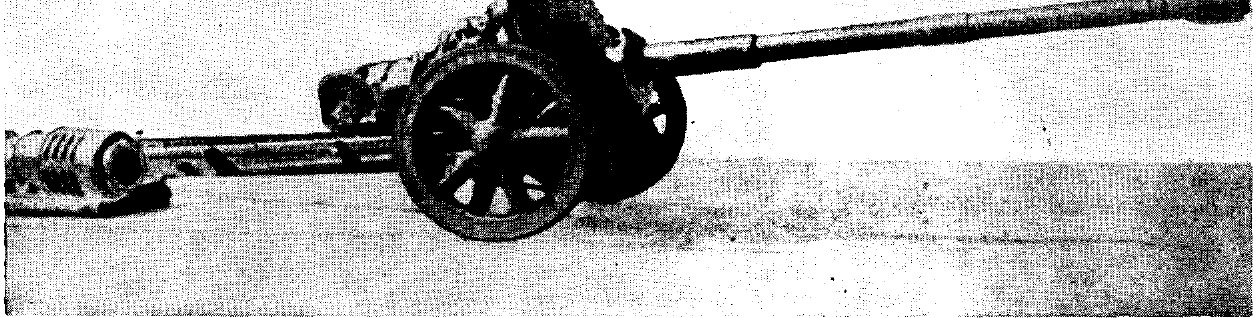
The 7.5 cm Pak 40 was a 75 mm antitank gun with a double-baffle muzzle brake and a semiautomatic horizontal sliding breech [2]. The 1945 handbook gives its weight in action as 3,136 pounds [1]. The 1943 handbook lists a 2.95-inch bore, an APCBC round weighing 15 pounds, and a gun weighing 1.5 tons [3]. Sources list HE, APCBC, AP 40 and hollow-charge rounds [4].
Early production guns had a muzzle velocity of 2,400 to 2,500 feet per second. A May 1943 Military Intelligence bulletin reported improvements that raised it to about 2,800 feet per second [4]. The same bulletin said that the Pak 40 and the 88-mm gave the same performance against armor at distances up to 2,500 yards, and that Army crews were to man the Pak 40, while the 88-mm had been borrowed from Air Force flak units [4].
The Company Officer's Handbook of 1944 gives the gun's weight as 3,000 pounds, and describes it as the step after the 50-mm Pak 38 and before the 88-mm Pak 43 [5].
Specifications, source by source
Every figure as the document printed it, with the sentence it came from and a link to the page. Values run from the earliest source to the latest. 2 figures changed over time, as new models appeared and intelligence improved.
| Attribute | Value as printedSource and quoted text |
|---|---|
| Caliber | 75 mm (2.95 in bore) (75 mm)Bore 2.95 in Handbook on German Military Forces (TM-E 30-451), 1 Sept 1943, p. 148“75-mm (Pak 40) | 2.95” |
| Weight (firing position / traveling)Changed over time | 1.5 tons (1,361 kg)Approximate weight Handbook on German Military Forces (TM-E 30-451), 1 Sept 1943, p. 148“75-mm (Pak 40) | 2.95 | 2,830 | 1.5 tons” 3,000 lb (1,361 kg)Company Officer's Handbook, 1944 Company Officer's Handbook of the German Army (1944), p. 55“3,000-pound 75-mm antitank gun (7.5 cm. Pak 40)” 3,136 lb (1,423 kg)Weight in action Handbook on German Military Forces (TM-E 30-451), March 1945, p. 343“Weight in action 3,136 pounds” |
| Muzzle velocityChanged over time | 2,400 to 2,500 ft/s (732 to 762 m/s)Early production Intelligence Bulletin, Vol. 1 No. 9 (May 1943), p. 59“When it was first brought out, the 75-mm antitank gun, model 40, had a muzzle velocity of only 2,400 to 2,500 feet per second” about 2,800 ft/s (853 m/s)After improvements (May 1943 report) Intelligence Bulletin, Vol. 1 No. 9 (May 1943), p. 59“the gun has a muzzle velocity of about 2,800 feet per second” 2,830 ft/s (863 m/s)Approximate, 1943 table Handbook on German Military Forces (TM-E 30-451), 1 Sept 1943, p. 148“75-mm (Pak 40) | 2.95 | 2,830” 3,250 ft/s (991 m/s)AP 40 projectile Handbook on German Military Forces (TM-E 30-451), March 1945, p. 343“Muzzle velocity (AP40) .3,250 feet per second” |
| Projectile weight | 15 lb (6.8 kg)APCBC round Handbook on German Military Forces (TM-E 30-451), 1 Sept 1943, p. 148“75-mm (Pak 40) | 2.95 | 2,830 | 1.5 tons | APCBC | 15 lbs.” |
| Ammunition types | HE, APCBC, AP 40, hollow chargeHollow charge also issued (May 1943 report) Intelligence Bulletin, Vol. 1 No. 9 (May 1943), p. 63“are provided with a hollow-charge round” Hollow charge not for use beyond 1,300 yd (1,190 m)German doctrine, per May 1943 report Intelligence Bulletin, Vol. 1 No. 9 (May 1943), p. 63“The Germans believe that the hollow-charge shell should not be used at ranges of more than 1,300 yards” |
| Penetration (comparison with 88-mm) | Same performance against armor as the 88-mm (88 mm)Up to 2,500 yd (May 1943 report) Intelligence Bulletin, Vol. 1 No. 9 (May 1943), p. 59“For all practical purposes the two guns give the same performance against armor at distances up to 2,500 yards” |
| Prime mover | Motor-drawn (towed) Handbook on German Military Forces (TM-E 30-451), March 1945, p. 343“Traction Motor-drawn” |
What Allied intelligence knew, and when
Military Intelligence bulletin reports Pak 40 muzzle velocity raised from 2,400-2,500 ft/s to about 2,800 ft/s.
1943 handbook table lists the 75-mm (Pak 40) with a 2,830 f/s muzzle velocity and APCBC round.
Handbook on German Military Forces (TM-E 30-451), 1 Sept 1943, p. 148
Photographs
Cropped from wartime documents, including some not otherwise cited on this page. Each caption says what the picture is and links to the page it was printed on.

More weapons
Sources
- [1]Handbook on German Military Forces (TM-E 30-451), March 1945 (1945). Page cited: 343. Not on this site yet; links go to the page on the Internet Archive.
- [2]Handbook on German Military Forces (CGSC copy) (1944). Page cited: 343. Not on this site yet; links go to the document on the CGSC Digital Library.
- [3]Handbook on German Military Forces (TM-E 30-451), 1 Sept 1943 (1943). Page cited: 148. Not on this site yet; links go to the page on the Internet Archive.
- [4]Intelligence Bulletin, Vol. 1 No. 9 (May 1943) (1943). Pages cited: 58, 59, 63. Not on this site yet; links go to the page on the Internet Archive.
- [5]Company Officer's Handbook of the German Army (1944). Page cited: 55. Not on this site yet; links go to the page on the Internet Archive.