Ju 87 Stuka
Junkers Ju 87 (Ju 87)
Dive bomber, Germany, as described in 5 wartime documents.
Also written as Ju-87K, Ju 87B, Ju 87D, Junkers 87, Junkers 87 (Stuka), Stuka.
What the sources say
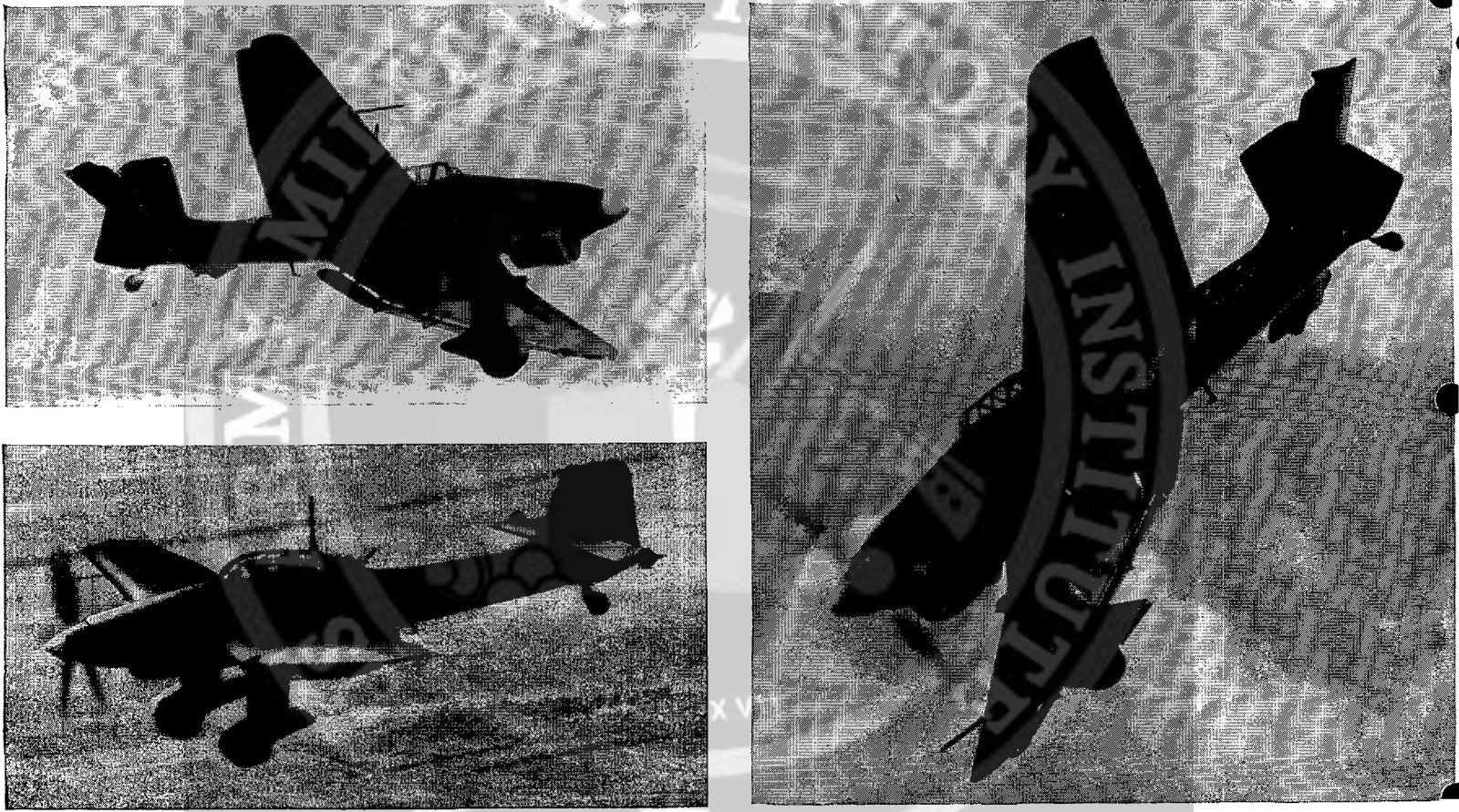
The Junkers Ju 87, known as the Stuka, is listed in the 1942 FM 30-35 as a dive bomber with a low-wing, all-metal monoplane design and fixed landing gear [1]. The same manual gives a crew of two, one 1,200-horsepower Junkers Jumo 211A engine, a diving speed of 430 miles per hour and a service ceiling of 27,890 feet [1].
The 1943 FM 30-30 describes the Ju 87B with a low inverted gull wing and fixed landing gear with wheel fairings, and gives maximum speed as 225 miles per hour at 15,000 feet with bombs and 245 miles per hour with bombs unloaded [2]. The 1943 handbook says that the Ju 87D in use was little different from the B and R series that appeared in 1939 and 1940 [3].
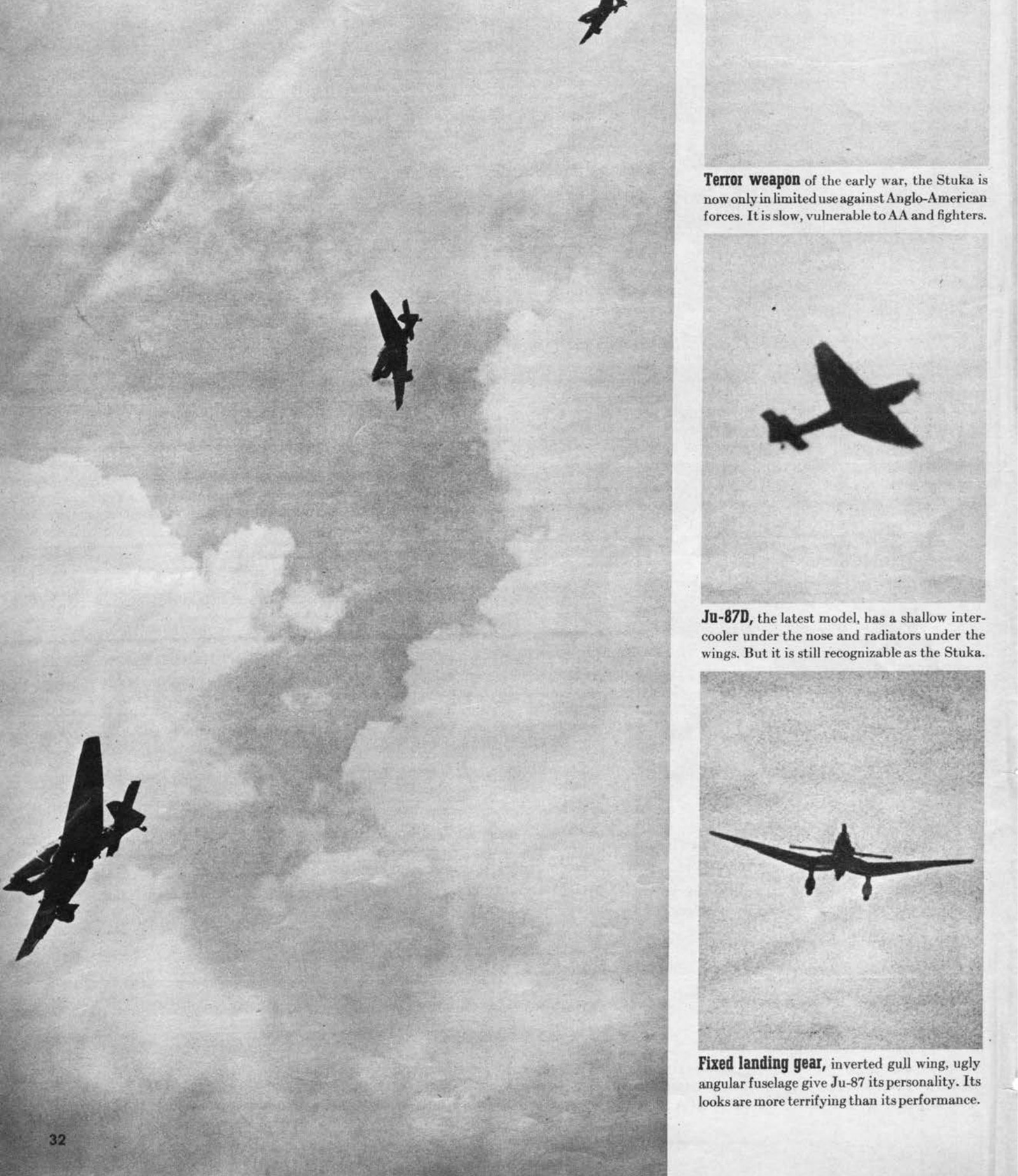
A 1944 US Army-Navy Journal of Recognition article says the Stuka was by then only in limited use against Anglo-American forces [5]. The 1945 TM-E 30-451 handbook says the Ju 87 "Stuka" dive bomber was still in limited use [4].
Specifications, source by source
Every figure as the document printed it, with the sentence it came from and a link to the page. Values run from the earliest source to the latest. 1 figure changed over time, as new models appeared and intelligence improved.
| Attribute | Value as printedSource and quoted text |
|---|---|
| Role | Dive bomber FM 30-35 Identification of German Aircraft (1942), p. 37“DIVE BOMBER JUNKERS JU-87” |
| Status (1944 sources) | Limited use against Anglo-American forces US Army-Navy Journal of Recognition Jan-Apr 1944, p. 113“now only in limited use against Anglo-American” |
| Crew | Two FM 30-35 Identification of German Aircraft (1942), p. 37“Crew: Two.” |
| Armament | Two fixed machine guns and one flexible rear machine gun FM 30-35 Identification of German Aircraft (1942), p. 37“Two machine guns, fixed-fuselage; one machine gun, flexible-fuselage, rear.” |
| Bomb load | One 1,100-pound and two 55-pound FM 30-35 Identification of German Aircraft (1942), p. 37“One 1,100-pound and two 55-pound.” One 1,100-pound and two 110-poundJu 87K FM 30-35 Identification of German Aircraft (1942), p. 39“One 1,100-pound and two 110-pound.” |
| Engine | One 1,200-horsepower Junkers Jumo 211A, liquid-cooled FM 30-35 Identification of German Aircraft (1942), p. 37“One 1,200-horsepower Junkers Jumo 211A, liquid-cooled.” |
| Maximum speed | 242 to 250 miles per hour; diving speed 430 miles per hour FM 30-35 Identification of German Aircraft (1942), p. 37“242 to 250 miles per hour. Diving speed, 430 miles per hour.” 225 miles per hour at 15,000 feet (with load); 245 miles per hour at 15,000 feet (bombs unloaded)Ju 87B FM 30-30 Aircraft Recognition Pictorial Manual (1943), p. 117“MAX. SPEED: 225 m. p. h. at 15,000 (with load)” |
| Service ceiling | 27,890 feet (8,501 m) FM 30-35 Identification of German Aircraft (1942), p. 37“Service ceiling: 27,890 feet.” 30,000 feet (not loaded); 25,000 feet (normal load)Ju 87B FM 30-30 Aircraft Recognition Pictorial Manual (1943), p. 117“30,000 ft. (not loaded)” |
| Maximum range | 498 miles at 186 miles per hour; 2.5 hours at cruising speedJu 87K FM 30-35 Identification of German Aircraft (1942), p. 39“2.5 hours at cruising speed; 498 miles at 186 miles per hour.” |
| SpanChanged over time | 45 feet (13.72 m) FM 30-35 Identification of German Aircraft (1942), p. 37“Wing span: 45 feet.” 45 ft. 4 in. (13.82 m)Ju 87B FM 30-30 Aircraft Recognition Pictorial Manual (1943), p. 117“SPAN: 45 ft. 4 in.” |
| Length | 36 ft. 6 in. (11.13 m)Ju 87B FM 30-30 Aircraft Recognition Pictorial Manual (1943), p. 117“LENGTH: 36 ft. 6 in.” |
| Models (sub-types) reported | Ju 87KJu 87K FM 30-35 Identification of German Aircraft (1942), p. 39“DIVE BOMBER JUNKERS JU-87K” Ju 87BJu 87B FM 30-30 Aircraft Recognition Pictorial Manual (1943), p. 117“GERMANY: Ju. 87B DIVE BOMBER” Ju 87C-1, with jettisonable undercarriageJu 87C-1 FM 30-30 Aircraft Recognition Pictorial Manual (1943), p. 117“one modification, the Ju 87C-1, has jettison-” Ju 87D, latest model in 1943-1944 sourcesJu 87D FM 30-30 Aircraft Recognition Pictorial Manual (1943), p. 117“model, the JU 87D is now in use (Photo B).” Ju 87DJu 87D Handbook on German Military Forces (TM-E 30-451, 1 Sept 1943), p. 294“Junkers, Ju. 87D,” Ju-87D, the latest modelJu 87D US Army-Navy Journal of Recognition Jan-Apr 1944, p. 113“Ju-87D, the latest model” |
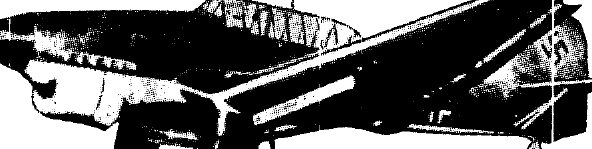
| Recognition features | Low inverted gull wing, in-line engine FM 30-30 Aircraft Recognition Pictorial Manual (1943), p. 117“Low inverted gull-wing” Fixed landing gear with wheel fairings FM 30-30 Aircraft Recognition Pictorial Manual (1943), p. 117“landing gear with wheel fairings.” |
What Allied intelligence knew, and when
little different from the B and R series which appeared in 1939 and 1940.
Handbook on German Military Forces (TM-E 30-451, 1 Sept 1943), p. 300
FM 30-35 (1942) identifies the Junkers Ju-87 'Stuka' as a dive bomber: a single-motor, low-wing monoplane with fixed landing gear.
FM 30-30 (1943) gives the Ju 87B a maximum speed of 225 mph at 15,000 ft with a load, and says the Ju 87D 'is now in use'.
FM 30-30 Aircraft Recognition Pictorial Manual (1943), p. 117
The Journal of Recognition (January to April 1944) says the Stuka was by then only in limited use against Anglo-American forces; the Ju-87D was the latest model.
The March 1945 handbook says the Ju 87 was still in limited use for night ground attack and had been largely superseded by fighter-bombers.
Handbook on German Military Forces (TM-E 30-451) (1945), p. 609
Photographs
Cropped from wartime documents, including some not otherwise cited on this page. Each caption says what the picture is and links to the page it was printed on.
More aircraft
Sources
- [1]FM 30-35 Identification of German Aircraft (1942). Pages cited: 37, 39. Not on this site yet; links go to the page on the Internet Archive.
- [2]FM 30-30 Aircraft Recognition Pictorial Manual (1943). Page cited: 117. Not on this site yet; links go to the page on the Internet Archive.
- [3]Handbook on German Military Forces (TM-E 30-451, 1 Sept 1943) (1943). Pages cited: 294, 300. Not on this site yet; links go to the page on the Internet Archive.
- [4]Handbook on German Military Forces (TM-E 30-451) (1945). Page cited: 609. Not on this site yet; links go to the page on the Internet Archive.
- [5]US Army-Navy Journal of Recognition Jan-Apr 1944 (1944). Page cited: 113. Not on this site yet; links go to the page on the Internet Archive.